Gaming stocks give investors a way to gain exposure to the video game industry. These companies can make games, publish titles, sell hardware, run online platforms, or provide game engines and services. The sector includes large global firms and smaller game developers. It also changes fast. A hit game can lift a company’s results, while a delayed release can hurt them. That makes research important.
Investors should look at more than a popular game or a strong brand. Revenue, profit, cash flow, debt, game sales, player activity, and future releases can all matter. This guide explains what gaming stocks are, how the industry works, what can move share prices, and what to check before making an investment decision. It also covers major risks and ways to compare gaming companies.
What Are Gaming Stocks?
Gaming stocks are shares of companies linked to the video game industry.
These companies can work in many parts of gaming. Some create games. Others publish them. Some sell consoles, graphics hardware, or gaming accessories.
There are also companies that provide software and technology used to build games.
The gaming industry has grown into a broad technology and entertainment market. It includes:
- Game developers
- Game publishers
- Console makers
- PC gaming companies
- Mobile gaming companies
- Game engine providers
- Graphics hardware companies
- Online gaming platforms
- Esports-related businesses
- Digital game marketplaces
This means gaming stocks do not all behave in the same way.
A company that makes consoles may have different revenue drivers from a mobile game developer. A chip maker may benefit from gaming hardware demand but also depend on other markets.
That is why investors should study each company on its own.
How Does the Gaming Industry Make Money?
Gaming companies can earn money in several ways.
The most basic model is game sales. A player buys a game, and the publisher receives revenue.
Digital distribution has changed this model. Players can buy and download games without buying a physical disc.
Many games also use extra purchases. These can include downloadable content, expansions, cosmetic items, subscriptions, and other digital products.
Mobile gaming often uses free-to-play models. The game may be free to download, while optional purchases generate revenue.
Subscription services are another model. Players may pay for access to a group of games or online features.
Hardware is also important. Console makers can earn money from console sales and related software or services.
Different business models create different risks. Investors should understand how a company makes its money before looking at its stock.
Why Do People Invest in Gaming Stocks?
Gaming is a large entertainment market with many types of customers.
Video games can also have long life cycles. A successful title may continue to generate revenue after its launch.
Online games can create recurring activity. Players may return for updates, new content, events, and expansions.
Mobile gaming can also reach a wide audience because smartphones are common consumer devices.
Another factor is the mix of technology and entertainment. Gaming companies can benefit from new hardware, better graphics, faster networks, and improved software.
Still, industry growth does not guarantee that every gaming stock will rise.
A growing market can contain both winners and losers.
One company may create a successful franchise. Another may spend heavily on a game that fails to meet expectations.
Good research is therefore more useful than simply choosing a company because gaming is popular.
Types of Gaming Stocks
The term “gaming stocks” covers several groups.
Game Developers
Developers create video games.
They may work on their own projects or work for publishers.
A developer’s results can depend on the success of its games. Development costs can also be high.
A game may take years to build. During that time, the company may spend money before earning revenue from the finished product.
Game Publishers
Publishers help bring games to the market.
Their work can include marketing, distribution, financing, partnerships, and business planning.
Large publishers may control several franchises.
A strong game portfolio can reduce dependence on one title. However, major releases can still have a large effect on financial results.
Console Companies
Console makers build gaming hardware and related services.
Examples include companies behind major console platforms such as Sony Group Corporation and Microsoft.
These businesses are much larger than gaming alone. Gaming is only one part of their overall operations.
That matters when investors assess them.
Buying one of these stocks is not the same as buying a pure-play game developer.
Graphics and Hardware Companies
Gaming also depends on computer hardware.
Graphics processors, CPUs, storage devices, displays, and other components support modern games.
NVIDIA is one well-known example of a company with major exposure to gaming hardware.
However, NVIDIA also operates in other technology markets. Its stock therefore reflects more than gaming demand.
Game Engine Companies
Game engines provide tools that developers use to build games.
An engine can support graphics, physics, sound, animation, and other parts of game development.
Unity Software is a well-known example.
Engine businesses may use different revenue models from traditional game publishers.
Major Factors That Can Affect Gaming Stocks
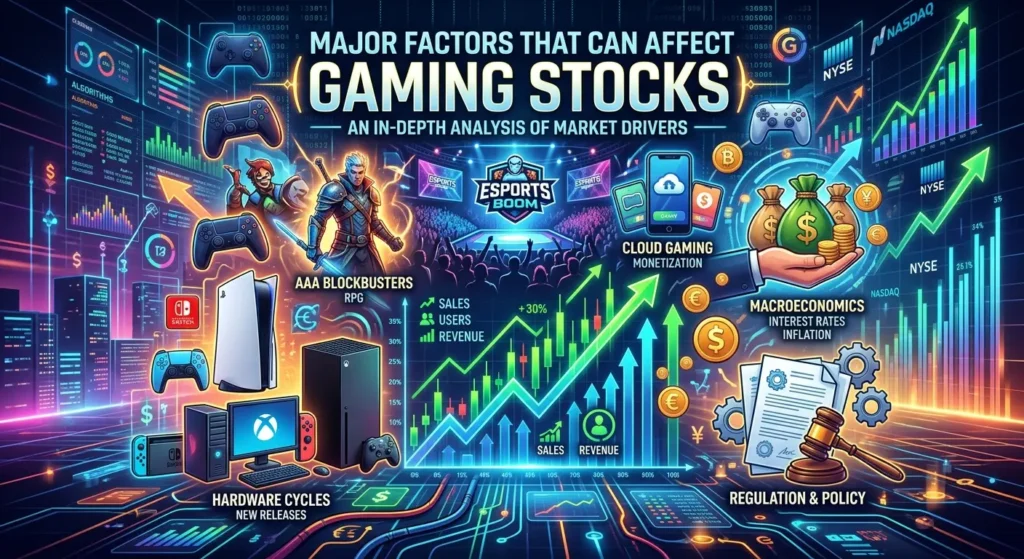
Gaming share prices can move for many reasons.
Game launches are one major factor.
A highly expected game can attract investor attention. Strong sales may help results. A weak launch can have the opposite effect.
Delays can also matter.
When a major game moves to a later release date, investors may change their expectations for revenue and profit.
Company guidance is another important factor.
Management may explain expected revenue, spending, margins, or future plans. Investors often use this information when judging a stock.
Other factors include:
- Game sales
- Player engagement
- New releases
- Delayed games
- Subscription growth
- Digital sales
- Mobile revenue
- Hardware demand
- Advertising revenue
- Development costs
- Marketing costs
- Acquisitions
- Competition
- Regulation
- Currency changes
A strong gaming brand does not remove these risks.
Why Game Releases Matter So Much
A successful game can become a major business asset.
Franchises can create repeat sales. They may also support expansions, merchandise, subscriptions, or other products.
The opposite can happen when a major release performs poorly.
Game development is expensive and takes time. A company may invest for years before a title reaches players.
This creates release risk.
Investors should look at the company’s full portfolio instead of focusing on one game.
Ask whether the company has several important titles or depends heavily on a small number of releases.
A diversified game portfolio can have a different risk profile from a company built around one major title.
What Makes a Gaming Stock Attractive?
There is no single feature that makes a stock attractive.
Investors often look for a combination of financial strength, business quality, and future growth.
Useful areas to study include:
Revenue Growth
Revenue shows how much money the company generates from its business.
Look at the trend over several reporting periods.
One strong quarter does not always show the full picture.
Profitability
Revenue alone is not enough.
A company can grow sales while spending heavily and producing weak profits.
Check operating income, net income, and margins.
Free Cash Flow
Cash generation can help show how much money remains after the company funds its operations and capital needs.
A company with healthy cash flow may have more flexibility for investment, debt payments, or acquisitions.
Balance Sheet
Debt matters.
A company with a large cash position may have more financial flexibility. A company with heavy debt may face greater pressure if business conditions weaken.
Game Portfolio
Look at the company’s games and franchises.
Are they diverse?
Does the company have upcoming releases?
How much revenue comes from its biggest titles?
These questions can help investors understand business concentration.
Gaming Stocks and Recurring Revenue
Recurring revenue can make a business model more predictable.
Gaming companies may earn recurring revenue from subscriptions, online services, in-game purchases, advertising, or ongoing content.
A game with a large active community can continue generating revenue after its original launch.
That can be useful for a business.
However, recurring revenue is not guaranteed forever.
Player interest can change. Competition can increase. A game can lose users.
Investors should look at the quality and stability of recurring revenue rather than assuming it will always grow.
The Role of Mobile Gaming
Mobile gaming is a major part of the broader gaming market.
Smartphones allow games to reach users without dedicated gaming hardware.
Mobile games can use free-to-play models, advertising, subscriptions, and optional purchases.
This creates a different business model from traditional premium games.
Mobile gaming companies may focus heavily on user acquisition and engagement.
Marketing costs can therefore be important.
Investors should study how much a company spends to attract users and how effectively it turns those users into revenue.
PC Gaming and Gaming Stocks
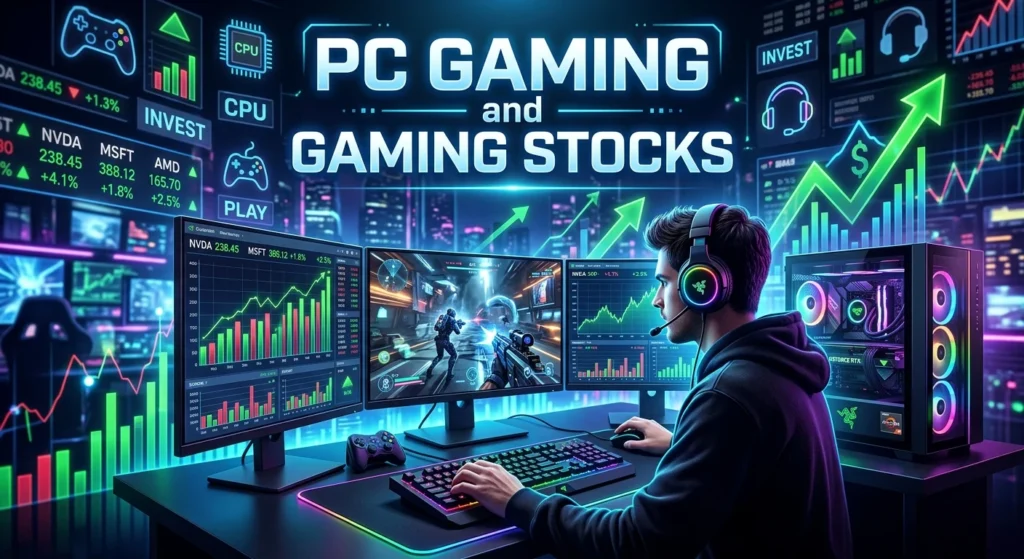
PC gaming supports several parts of the industry.
Players may spend money on games, graphics cards, processors, monitors, storage, and accessories.
This creates opportunities for both software and hardware companies.
PC gaming is also linked to digital marketplaces and online services.
Companies with exposure to PC gaming may not be pure gaming businesses. A hardware company may sell products to data centers, businesses, creators, and other customers as well.
That makes it important to understand total business exposure.
Console Gaming and Gaming Stocks
Console gaming includes hardware, software, online services, and digital content.
Major platforms compete for players.
A console ecosystem can create several revenue streams. Hardware can bring users into the platform, while games and services can generate additional revenue.
Investors should look at the whole ecosystem.
A company may earn money from its own games, third-party games, subscriptions, accessories, and digital services.
The exact mix varies by company.
Cloud Gaming
Cloud gaming lets users play games through remote computing systems.
The game runs on a remote server, while the player’s device receives the video and sends back input.
This model can reduce the need for powerful local hardware in some use cases.
Cloud gaming also requires strong network performance.
The business impact of cloud gaming is still different from traditional game sales. Investors should examine the specific company’s cloud strategy rather than assuming the entire sector will benefit equally.
Esports and Gaming Stocks
Esports is another part of the gaming ecosystem.
It includes organized competitive gaming, teams, events, media, and related businesses.
However, esports should not be treated as the same thing as the entire gaming industry.
A gaming company may have little or no direct exposure to esports.
Investors should check how much of a company’s business actually depends on competitive gaming.
Gaming Stocks and Artificial Intelligence
Artificial intelligence is becoming important across technology.
Gaming companies may use AI in areas such as development tools, animation, testing, moderation, customer support, and game systems.
Hardware companies can also benefit from demand for computing products used in AI.
This creates an important distinction.
A company with gaming exposure may also have large AI or data center exposure.
Investors should identify which business segments drive the company’s results.
Do not assume that an AI-related stock is automatically a gaming stock.
Risks of Investing in Gaming Stocks
Gaming stocks can carry significant risks.
Hit-Driven Business Models
A major game can succeed or fail.
That can create uneven results.
High Development Costs
Large games may require years of development.
A project can consume significant resources before it generates revenue.
Delays
Game launches can be delayed for many reasons.
A delay can shift revenue from one reporting period to another.
Competition
Gaming is highly competitive.
Players have many choices. Companies must compete for attention, spending, and development talent.
Changing Player Trends
Gaming habits can change.
A popular genre today may lose attention later.
Regulation
Governments can introduce rules that affect digital purchases, privacy, advertising, content, or online services.
Platform Dependence
Some developers depend on major console, PC, or mobile platforms.
Changes to platform rules can affect their business.
Currency Risk
Large international companies may earn revenue in several currencies.
Exchange rate changes can affect reported results.
How to Research Gaming Stocks
Good research starts with the company’s financial reports.
Look at revenue and profit trends.
Then study the balance sheet and cash flow.
Next, examine the business segments.
Find out where the company makes its money.
Review major game franchises and upcoming projects.
Pay attention to management guidance.
It can also help to compare a company with competitors.
Do not rely only on social media posts or gaming forums.
Popular opinion can change quickly. Financial reports and official company disclosures provide stronger evidence for investment research.
Key Metrics to Watch
Different investors use different metrics, but several can help when studying gaming companies.
| Metric | What it can show |
| Revenue | Size and growth of sales |
| Operating income | Profit from core operations |
| Net income | Overall reported profit |
| Free cash flow | Cash generated after key spending |
| Operating margin | Profitability of operations |
| Debt | Financial obligations |
| Cash | Financial flexibility |
| User growth | Changes in the customer base |
| Engagement | Activity within digital products |
| Bookings or similar measures | Certain future or contracted revenue indicators |
| Revenue by segment | Where business results come from |
No single metric gives the full picture.
Use several measures together.
How to Compare Two Gaming Stocks
Start with the business model.
Are both companies developers? Are they publishers? Does one sell hardware?
Next, compare financial strength.
Look at revenue growth, profit, cash flow, debt, and cash.
Then examine future plans.
Does one company have a larger game pipeline? Does another have more recurring revenue?
Valuation also matters.
A strong company can still be a poor investment if its stock price already reflects very high expectations.
This is why business quality and valuation should be studied together.
Valuation Matters With Gaming Stocks
Investors often use valuation measures to compare stocks.
Common measures include price-to-earnings, price-to-sales, enterprise value to earnings measures, and free cash flow yield.
The best metric depends on the business.
A mature profitable company can be easier to assess with earnings-based measures.
A company that is still investing heavily may require a different approach.
Investors should also compare valuation with growth and risk.
A high valuation may reflect strong expectations. If those expectations are not met, the stock can face pressure.
Why Popular Gaming Stocks Can Be Risky
A famous company is not automatically a good investment.
Strong brands can attract customers. They can also attract investors.
That can create high expectations.
If investors expect very strong growth, even a good financial result may disappoint the market if it falls below expectations.
This is why research should focus on future expectations as well as past performance.
Ask what the market may already expect.
Then consider what could make those expectations higher or lower.
Diversification and Gaming Stocks
Investing only in one industry can increase risk.
Gaming companies can face similar challenges at the same time.
A weak consumer environment, platform change, or industry trend can affect several businesses.
Diversification can help reduce dependence on one company or sector.
The right level of diversification depends on each investor’s goals, time frame, and risk tolerance.
Gaming stocks can be part of a broader portfolio rather than the entire portfolio.
Long-Term vs. Short-Term Investing
Gaming stocks can attract both short-term traders and long-term investors.
Short-term movements may follow earnings reports, game announcements, delays, acquisitions, or market news.
Long-term investors may focus more on the company’s ability to grow revenue and cash flow over time.
Neither approach removes risk.
Short-term trading requires attention to market movements. Long-term investing requires patience and confidence in the business.
Your time horizon should shape how you evaluate the stock.
What to Avoid When Choosing Gaming Stocks
Avoid buying a stock only because you like its games.
Being a customer and being a shareholder are different roles.
A great game can be popular without making the company highly profitable.
Also avoid relying on one future game.
Release schedules can change. Development can take longer than expected.
Do not ignore valuation.
A good company can still be expensive.
Finally, avoid treating online predictions as facts. Check the company’s own financial information and official disclosures before making a decision.
A Simple Gaming Stock Research Checklist
Before researching a company, ask:
- What does the company sell?
- How does it make money?
- Which games or products drive revenue?
- How fast is revenue growing?
- Is the company profitable?
- Does it generate free cash flow?
- How much debt does it have?
- How much cash does it hold?
- Does it depend on one major title?
- Does it depend on one platform?
- What are its major future projects?
- What risks could hurt results?
- How does its valuation compare with its business outlook?
These questions can help turn a simple stock search into a deeper review.
Are Gaming Stocks a Good Investment?
There is no universal answer.
Some gaming companies may have strong brands, useful technology, healthy finances, or valuable franchises.
Others may face weak sales, high costs, debt, or strong competition.
The gaming sector can offer growth opportunities, but it can also be volatile.
Investors should match any stock choice with their own goals and risk level.
Research is especially important because gaming companies can have very different business models.
Gaming Stocks to Watch by Industry Segment
Rather than focusing only on a list of tickers, investors can organize gaming stocks by business type.
For example:
Publishers and developers: These companies depend heavily on game releases, franchises, and digital sales.
Console platforms: These businesses combine hardware with games, services, and digital ecosystems.
Hardware companies: These firms may benefit from gaming demand but can also depend on other technology markets.
Game engine companies: Their results can depend on developer adoption and software revenue.
Mobile gaming companies: These businesses often rely on user engagement, advertising, and digital purchases.
This approach makes it easier to understand what you are actually buying.
How Game Delays Affect Investors
A delay does not always mean a game will fail.
Sometimes a company delays a release to improve the product.
The short-term market reaction can still matter.
Investors may change their revenue expectations when a major release moves.
That can affect forecasts for a quarter or full year.
The right response is not to assume the worst.
Instead, examine why the game was delayed, how important it is to the company, and whether other products can support revenue during the delay.
How Acquisitions Affect Gaming Stocks
Gaming companies sometimes buy other studios or technology businesses.
An acquisition can add games, talent, technology, or new customers.
It can also increase costs and debt.
Integration is another risk.
Buying a company does not guarantee that the combined business will perform better.
Investors should look at the purchase price, expected benefits, funding method, and possible risks.
The same principle applies to mergers and other major corporate deals.
The Importance of Game Franchises
A strong franchise can become a long-term asset.
A successful series may produce several games over many years.
It can also support expansions and related products.
However, franchises can lose popularity.
A company must continue to create products that players want.
Investors should therefore look at both the current strength of a franchise and the company’s ability to build new ones.
Final Thoughts Before Buying Gaming Stocks
Gaming stocks can offer exposure to an industry that combines entertainment, software, hardware, and online services.
But the sector is not simple.
One company may depend on game launches. Another may earn much of its revenue from hardware. A third may have major exposure to cloud technology or artificial intelligence.
That difference matters.
Before buying a gaming stock, study the company’s financial health, business model, valuation, game portfolio, competition, and risks.
Avoid making a decision based only on a favorite game or a popular brand.
A strong investment process looks beyond the game itself.
Conclusion
Gaming stocks cover a wide part of the technology and entertainment market. They include game developers, publishers, console companies, hardware makers, game engine businesses, and mobile gaming firms.
The industry offers many ways to invest, but each company has its own risks and opportunities. Game launches, player demand, subscriptions, hardware sales, development costs, competition, and platform changes can all affect results.
Investors should study revenue, profits, cash flow, debt, valuation, and future projects. It is also important to understand how each company makes money.
Gaming can be an exciting industry, but excitement should not replace research. A careful approach can help investors make more informed decisions and understand the risks before putting money into gaming stocks.
FAQs
1. What are gaming stocks?
Gaming stocks are shares of companies connected to the video game industry. They can include game developers, publishers, console companies, gaming hardware makers, game engine providers, and other businesses with gaming exposure.
2. Are gaming stocks risky?
Yes. Gaming stocks can face risks from game delays, weak releases, high development costs, competition, changing player preferences, regulation, and platform changes. Risk also varies greatly between individual companies.
3. What should I look for when researching gaming stocks?
Study the company’s revenue, profit, free cash flow, debt, cash, valuation, game portfolio, future releases, and business model. It is also useful to understand how dependent the company is on one game, franchise, or platform.
4. Can gaming stocks benefit from mobile gaming?
Some companies can benefit from mobile gaming through game sales, advertising, subscriptions, and in-game purchases. The effect depends on the company’s actual exposure to the mobile market and its ability to attract and retain players.
5. Are gaming stocks good for long-term investment?
Some gaming companies may have qualities that suit long-term investors, such as strong franchises, recurring revenue, healthy cash flow, or competitive advantages. However, suitability depends on the individual company, valuation, risk tolerance, and investment goals.