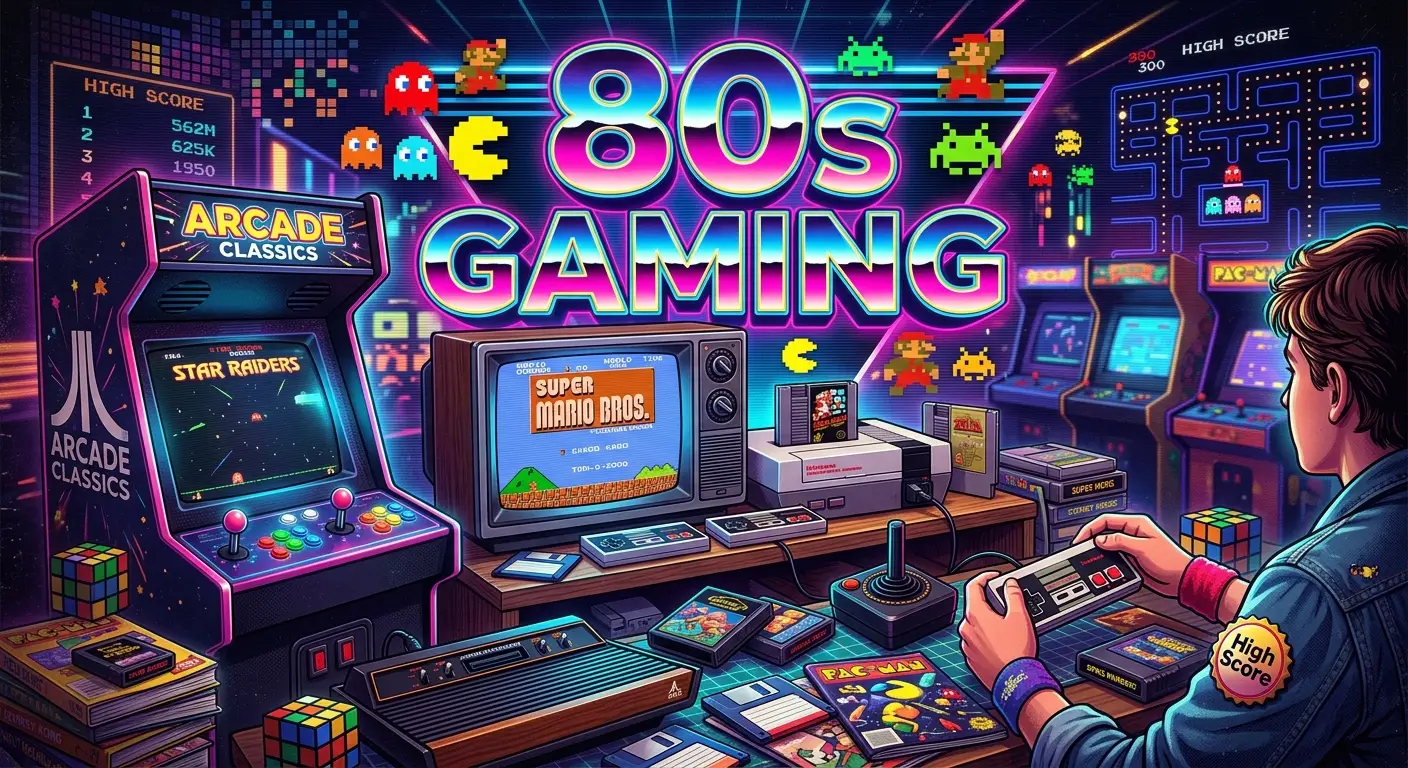
The 80’s gaming era changed video games forever. It was a time when simple ideas became huge hits. Arcades became social places where players met, watched others play, and tried to beat high scores. Home consoles also grew in popularity. Players could enjoy games at home instead of always visiting an arcade. Games from this period often had simple controls, clear goals, bright graphics, and catchy sounds.
Yet their simple design did not make them easy. Many titles demanded skill, timing, and patience. The 80’s also helped shape genres that are still popular today, including platform games, racing games, action games, shooters, and adventure games. For many players, this era remains a key part of gaming history. It also offers useful lessons about game design, creativity, and fun.
What Was 80’s Gaming?
80’s gaming refers to video games created and played during the 1980s. This period is important because gaming moved through major changes in both arcades and homes.
Arcade gaming was a major part of the era. Players visited arcades to play machines that were built for one game. Each machine had its own screen, controls, speakers, and game software.
Home gaming was also growing. Consoles gave people a way to play games in their living rooms. This helped video games become part of everyday home entertainment.
Computers played a role too. Many people used home computers for games. These systems offered a different experience from arcade machines and consoles.
The games themselves were often easy to understand. A player could look at the screen and quickly learn the main goal. The challenge came from mastering the controls and learning the game.
That design style still matters today. Modern games may have large worlds and complex systems, but many still use the same basic idea: give players a clear goal and make improvement feel rewarding.
Why 80’s Gaming Became So Popular
Several factors helped gaming grow during the 1980s.
First, arcade games created a social experience. Players did not just play alone. Friends could watch each other, share tips, and compete for better scores.
Second, home consoles made gaming more convenient. Players could enjoy games without traveling to an arcade.
Third, game design became more creative. Developers experimented with new characters, worlds, challenges, and play styles.
The technology of the time also encouraged creativity. Developers had limits on memory, graphics, sound, and processing power. They had to make strong games with limited resources.
Those limits were not always a problem. They pushed designers to focus on the parts that mattered most.
A game did not need realistic graphics to be fun. It needed good controls, a clear challenge, and a reason to keep playing.
This idea became one of the strongest lessons from the 80’s gaming era.
Arcade Gaming in the 1980s
Arcades were a central part of gaming culture in the 1980s.
An arcade machine usually focused on one game. Players stood or sat near the machine and used controls such as a joystick and buttons.
The goal could be simple. Players might need to clear levels, defeat enemies, race against others, or earn a high score.
High scores were especially important. A player could see how well they performed compared with others.
This created a strong reason to replay a game.
One failed attempt did not always feel like the end. Instead, it could feel like a lesson. Players learned enemy patterns, level layouts, and timing.
Arcade games also made spectators part of the experience. A skilled player could attract a small crowd. Others might watch and learn before trying the game themselves.
This helped create a gaming culture based on competition and shared experience.
Famous 80’s Arcade Games
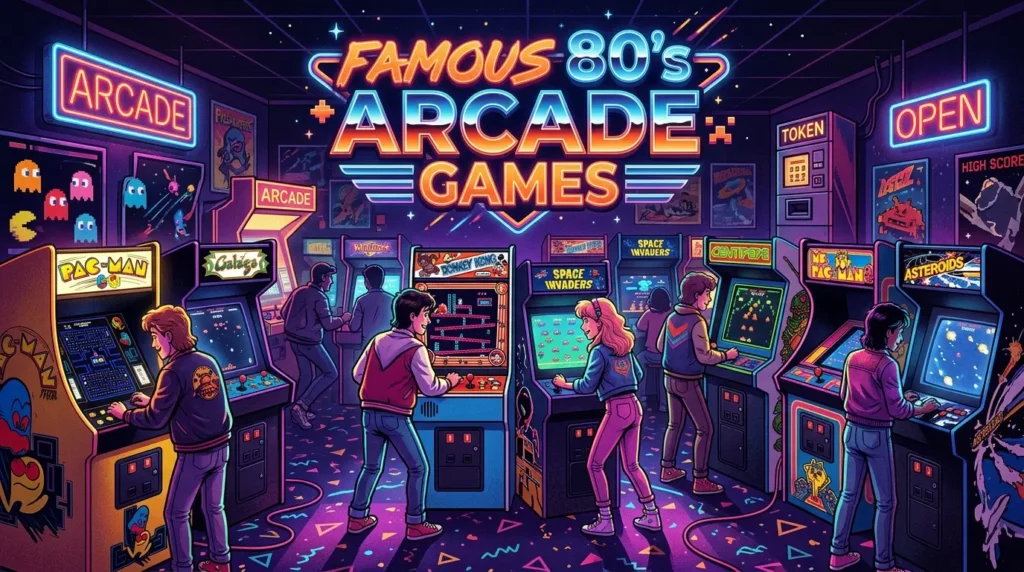
The decade produced many games that became important names in gaming history.
Pac-Man became one of the best-known arcade games. Its basic idea was easy to understand. Players moved through a maze while avoiding enemies and collecting items.
Donkey Kong introduced players to a platform-style challenge. It also helped establish Mario as a major video game character.
Galaga became known for its space-shooter gameplay. Players controlled a ship and fought waves of enemies.
Frogger used simple movement and timing. Players had to guide a character across dangerous areas while avoiding hazards.
Centipede offered fast action with a trackball control system. Its screen filled with enemies and obstacles as the player tried to survive.
These games had different themes, but they shared important qualities. Their controls were easy to learn. Their challenges were clear. They encouraged repeated play.
That combination helped make arcade gaming so powerful.
The Rise of Home Consoles
Arcades were not the only important part of 80’s gaming.
Home consoles became a major way for people to play video games. A console connected to a television and used game cartridges or other forms of game media.
The Nintendo Entertainment System became especially important in the later part of the decade. It helped bring console gaming to a large audience.
The system became known for games such as Super Mario Bros., The Legend of Zelda, and Metroid.
Other systems also played a role in the era. The Atari 2600 remained part of the wider gaming story, while the Sega Master System competed in the console market.
Home gaming offered a different experience from arcades.
Players did not need coins for every attempt. They could sit at home and spend more time learning a game.
This helped games become longer and more focused on progression.
The Nintendo Entertainment System Era
The Nintendo Entertainment System, often called the NES, became one of the most important consoles of the 1980s.
Its games helped shape several popular genres.
Super Mario Bros. showed how platform games could combine movement, exploration, enemies, power-ups, and level design.
The Legend of Zelda offered exploration and discovery. Players could move through a larger game world and find items that helped them progress.
Metroid focused on exploration and ability-based progression. New abilities could open paths that were not available earlier.
These games showed that console games could offer more than short arcade-style sessions.
Players could learn a world, improve their skills, and make progress over time.
The ideas introduced during this period still influence modern game design.
Popular Genres in 80’s Gaming
The 1980s helped establish many game genres.
Platform Games
Platform games focus on movement, jumping, obstacles, enemies, and level design.
Super Mario Bros. became a major example of the genre.
Good platform games reward timing. A player must learn when to jump, where to move, and how to avoid danger.
Shoot ‘Em Ups
Shoot ’em ups place players in fast action. The player often controls a ship or character and attacks waves of enemies.
Space Invaders and Galaga helped define this style of play.
These games often depend on reaction speed and pattern recognition.
Racing Games
Racing games gave players a chance to control vehicles and compete against time or other racers.
Early racing games had much simpler visuals than modern racing titles. Still, they introduced important ideas such as speed, steering, tracks, and competition.
Adventure Games
Adventure games placed more focus on exploration, puzzles, items, and story.
The Legend of Zelda helped make exploration a major part of console gaming.
Action Games
Action games covered many styles. They could include combat, movement, enemies, and fast reactions.
Many 80’s games mixed several types of gameplay instead of following one strict genre.
80’s Gaming Graphics
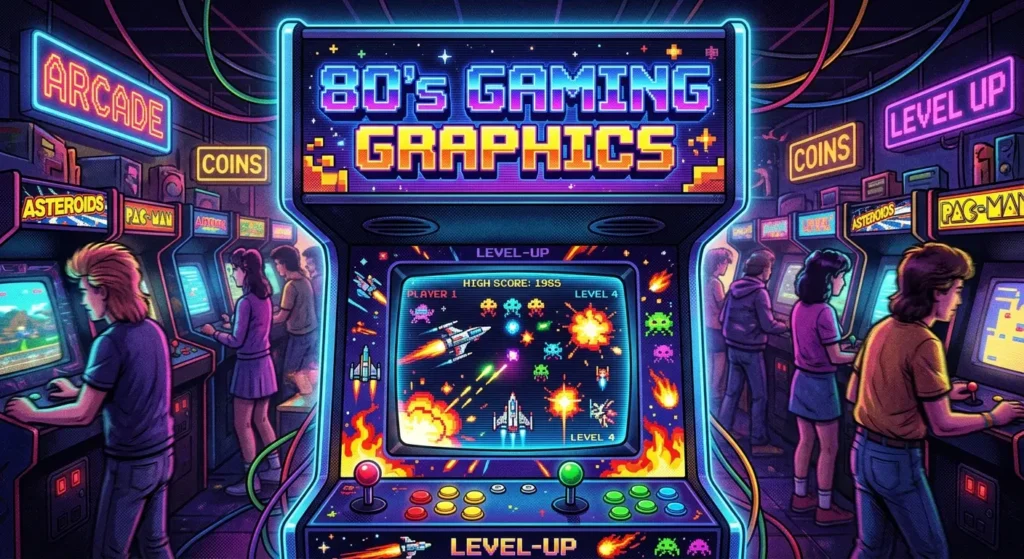
Modern players may find 80’s graphics very simple. That is because the technology had strict limits.
Games often used small sprites and limited colors. Characters could have only a few visual details.
Backgrounds were also simple.
Despite those limits, developers found clever ways to make games easy to recognize.
A strong character design could work with only a few pixels. A bright color could help separate an enemy from the background.
The limited graphics also created a distinct visual style.
Pixel art became closely linked with classic gaming.
Today, many developers still use pixel art. Some modern games use it as a creative choice rather than a technical requirement.
That shows how the visual language of 80’s gaming continues to influence new games.
Sound and Music in 80’s Games
Sound was another important part of the era.
Game systems could not produce the rich soundtracks found in many modern games. Developers had to work within technical limits.
Short musical patterns became common.
Simple sound effects could also tell the player what happened. A sound might indicate a jump, hit, bonus, enemy, or failure.
Music could make a game memorable.
Some classic game themes are still recognized today because they were built around short and memorable musical ideas.
The limited technology encouraged composers to think differently. They had to create music that worked well with a small number of sound channels.
This helped create the classic electronic sound linked with retro gaming.
Why 80’s Games Could Feel So Difficult
Many 80’s games are remembered as difficult.
One reason was their design.
Arcade games were often built around repeated play. Players had to learn through practice.
A player might lose because of poor timing. The next attempt gave them a chance to correct the mistake.
Limited lives were also common in many games. Losing a life created pressure and made mistakes important.
Some games used enemy patterns. Once players learned those patterns, they could perform better.
This kind of challenge is different from simply making a game unfair.
Good challenge teaches the player through play. A player learns what works and what does not.
That idea remains important in modern games.
The Role of High Scores
High scores were a major part of classic arcade culture.
A score gave players a simple way to measure success.
There was no need for a large online ranking system. The score itself could create competition.
Players could try to beat their own record. They could also compete with friends.
This added replay value.
The same game could remain interesting because the player wanted to improve.
Modern games still use similar ideas. Leaderboards, ranks, medals, achievements, and score systems all build on the basic desire to improve.
The high-score system was simple, but it was powerful.
80’s Gaming and Gaming Culture
Gaming in the 1980s was more than playing games.
Arcades became places where gaming culture grew.
Players could talk about games, share strategies, and watch skilled players.
Gaming magazines also helped spread information. They gave players news, reviews, tips, previews, and other game-related content.
Television and advertising also helped video games reach wider audiences.
Characters became recognizable beyond the games themselves.
This was an important step toward the modern gaming industry, where game characters can become major entertainment brands.
Home Computers and 80’s Gaming
Home computers were another important part of gaming history.
Systems such as the Commodore 64, ZX Spectrum, and Amstrad CPC were used for games as well as other tasks.
Computer gaming could feel different from console gaming.
Some games used keyboards. Others supported joysticks or other controllers.
Computer games also explored different genres. Adventure games, strategy games, simulations, and action titles all found audiences.
The home computer scene showed that gaming did not have to follow one format.
It also helped create a culture of experimentation.
Developers could try ideas that might not fit the typical arcade or console model.
The Role of Game Cartridges
Cartridges were an important part of many 80’s consoles.
A cartridge contained the game software and could be inserted into the console.
This made it possible to switch between games without replacing the entire machine.
Cartridges also became part of the physical gaming experience.
Players had game collections that they could keep, trade, or share.
The physical nature of games was different from today’s digital libraries.
There were no downloads in the modern sense. Getting a new game often meant buying a physical product.
That made game ownership feel more visible.
Why Retro Gaming Still Matters
80’s gaming remains popular because these games are easy to understand but often hard to master.
A player can learn the main goal quickly.
There may be little need for long tutorials or complex menus.
That makes many classic games easy to pick up.
Retro gaming also offers a clear view of how game design developed.
Modern games use many ideas that have roots in earlier decades.
Platforming, power-ups, boss fights, score systems, maze design, scrolling levels, and exploration all became important parts of gaming history.
Playing older games can help people understand where these ideas came from.
80’s Gaming for New Players
You do not need to grow up in the 1980s to enjoy these games.
New players can start with well-known titles and learn their basic controls.
It is best to begin with a game that matches your interests.
If you enjoy fast action, an arcade shooter may be a good choice.
Platform fans can explore classic platform games.
Players who enjoy exploration may prefer adventure games.
The key is to approach older games with the right expectations.
Do not expect modern graphics or complex systems.
Instead, focus on the gameplay.
Notice how the game teaches movement. Watch how enemies behave. Study the level design.
You may find that a game with simple visuals can still offer a strong challenge.
How to Enjoy 80’s Gaming Today
There are several ways to experience classic games today.
Some older games are available through official collections and modern re-releases.
Classic consoles may also be available in updated forms.
Another option is to play retro-inspired modern games. These titles use older visual styles and design ideas while adding modern features.
When playing older games, consider the original hardware and controls.
A game designed around an arcade joystick may feel different with a modern controller.
Display settings can matter too. Old games were designed for older screens, so their visuals may look different on modern displays.
The goal is not always to make an old game look new.
Sometimes the original style is part of the experience.
Lessons Modern Developers Can Learn
80’s gaming offers several useful lessons for modern developers.
Keep the Main Goal Clear
Players should understand what they are trying to do.
A simple goal can be powerful when the gameplay around it is strong.
Make Controls Easy to Learn
Good controls help players focus on the game instead of fighting the interface.
Classic games often used only a few buttons.
That limitation forced developers to make each input meaningful.
Reward Practice
A strong game can make players feel better as their skills improve.
The player should learn from mistakes.
Use Strong Visual Ideas
A character does not need thousands of details to be memorable.
Clear shapes and simple designs can work well.
Build Replay Value
High scores and increasing difficulty gave classic games a reason to play again.
Modern games can use different systems to create the same feeling of improvement.
80’s Gaming vs. Modern Gaming
The biggest difference is technology.
Modern games can create huge worlds with detailed graphics, advanced physics, voice acting, online systems, and complex artificial intelligence.
80’s games had far fewer technical resources.
Yet the basic purpose remained similar.
Both eras try to give players an enjoyable challenge.
Modern games often focus on long stories and large worlds. Many 80’s games focused more on short sessions and repeated play.
Neither approach is automatically better.
They simply reflect different technology, audiences, and design goals.
A modern game can learn from the clarity of classic design. A retro game can benefit from modern tools.
The two styles can work together.
The Lasting Influence of 80’s Gaming
The influence of the decade can still be seen across the gaming industry.
Platform games remain popular.
Retro-style graphics appear in new releases.
Arcade collections continue to introduce classic titles to new audiences.
Modern developers also revisit old ideas and combine them with new mechanics.
Characters from the period remain recognizable.
The design lessons are perhaps even more important than the individual games.
The 1980s showed that strong gameplay could work within strict limits.
Developers had to focus on what players could see, understand, and control.
That focus helped create games that remain easy to pick up decades later.
Why 80’s Gaming Is Still Special
The appeal of 80’s gaming comes from its simplicity, creativity, and challenge.
Games from this period did not need massive worlds to keep players interested.
A small screen could offer a deep challenge.
A few buttons could create complex skill.
A simple sound could become memorable.
A short level could encourage dozens of attempts.
The era also represents an important stage in gaming history. Arcades, consoles, and home computers helped shape the medium into what it is today.
For longtime players, these games can bring back memories of an earlier gaming culture.
For new players, they offer a chance to see how classic ideas began.
That makes the decade worth exploring.
Conclusion
80’s gaming helped build the foundation for much of modern video game culture. Arcades made gaming a social activity, while home consoles and computers brought games into people’s homes. Developers worked with limited hardware, but those limits encouraged simple controls, clear goals, strong characters, and creative gameplay. Games such as Pac-Man, Donkey Kong, Galaga, Super Mario Bros., and The Legend of Zelda showed how different styles could attract players. The decade also helped shape platform games, shooters, adventure games, racing games, and other genres. Today, retro games remain useful because they show the value of focused design. Their graphics may look simple, but their ideas remain powerful. Whether you are a longtime fan or a new player, exploring 80’s gaming can help you understand where many modern gaming ideas began.
FAQs
1. What is 80’s gaming?
80’s gaming refers to video games created and played during the 1980s. It includes arcade games, home console games, and computer games from that decade.
2. What were popular 80’s gaming systems?
Popular systems from the era included the Atari 2600, Nintendo Entertainment System, Sega Master System, Commodore 64, ZX Spectrum, and other home computers and consoles.
3. What were some famous 80’s games?
Famous games from the decade include Pac-Man, Donkey Kong, Galaga, Frogger, Super Mario Bros., and The Legend of Zelda.
4. Why were 80’s games often difficult?
Many games focused on repeated play and skill improvement. Players often learned enemy patterns, level layouts, and timing through practice.
5. Why is 80’s gaming still popular today?
80’s gaming remains popular because of its simple controls, memorable design, arcade-style challenge, pixel art, and lasting influence on modern video games.