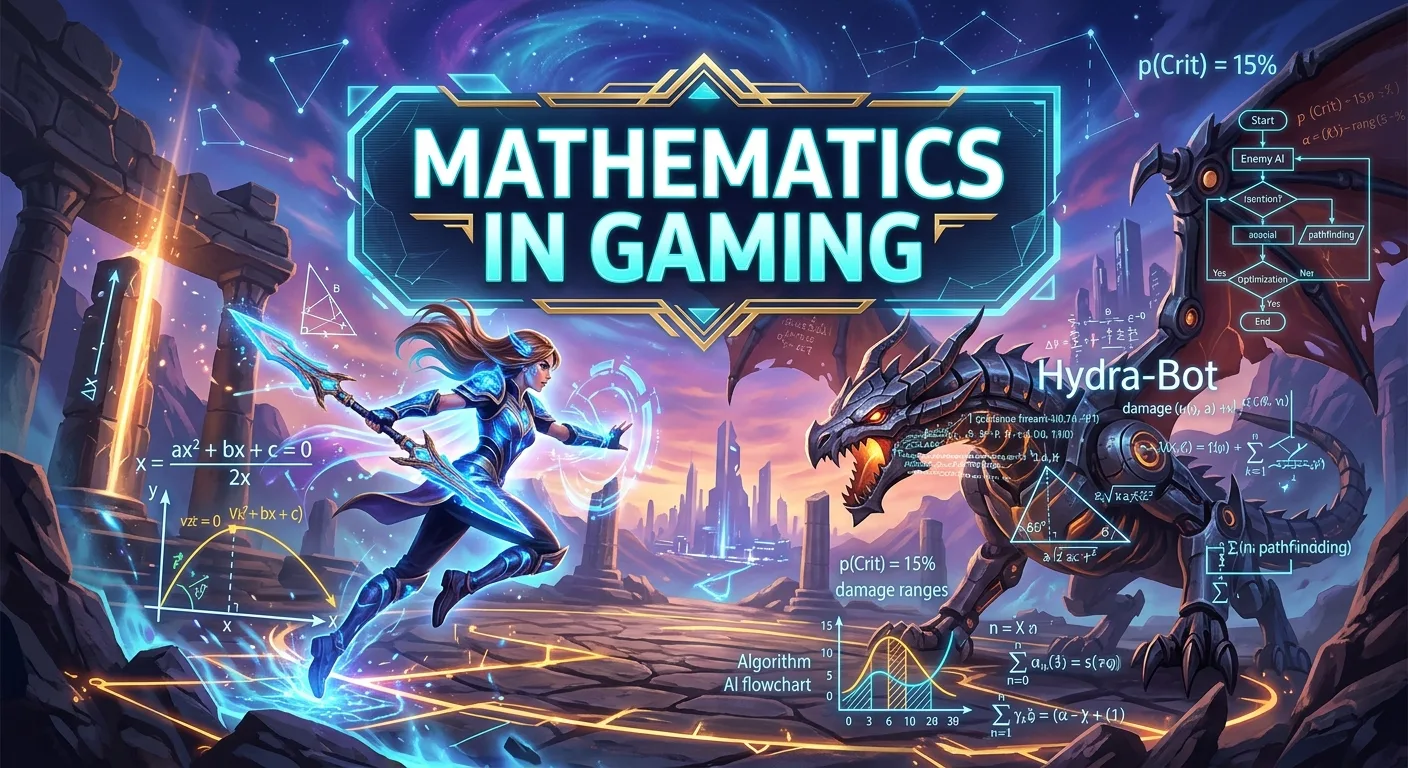
Gaming is not only about fast reactions, exciting stories, or powerful graphics. Mathematics plays an important role behind almost every modern game. From character movement and realistic physics to scoring systems, artificial intelligence, probability, and 3D graphics, mathematical concepts help developers create interactive experiences. Players also use mathematics, often without realizing it, when they calculate damage, manage resources, estimate probabilities, or choose the best strategy.
Understanding mathematics in gaming can make games more interesting and can also help students see how mathematical ideas work in real life. Whether you enjoy mobile games, racing games, strategy titles, puzzle games, or competitive esports, mathematics is working in the background. This article explores the major ways mathematics shapes game design, development, performance, and player strategy.
The Role of Mathematics in Gaming
Mathematics provides the logical foundation that allows a game to function correctly. A game world may look creative and artistic, but its movement, timing, scoring, and interactions usually depend on mathematical rules.
Game developers use numbers and formulas to define how objects behave. For example, a character’s position can be represented using coordinates. The game calculates where the character should move when the player presses a key or moves a controller. Speed, direction, acceleration, and distance all involve mathematical relationships.
Mathematics also helps developers create balanced gameplay. If one weapon causes too much damage or one character has an unfair advantage, developers can adjust numerical values to improve the player experience. Health points, experience points, cooldown timers, and resource systems all depend on calculations.
In addition, mathematics supports performance optimization. Developers must calculate how many objects, effects, and characters a system can process smoothly. Efficient algorithms and mathematical models can help games run better on different devices.
The importance of mathematics in gaming continues to grow as games become more advanced. Modern titles use mathematical systems for realistic physics, online networking, procedural generation, machine learning, and immersive 3D environments. Mathematics is therefore not a separate part of gaming. It is one of the core systems that makes digital games possible.
Coordinate Systems and Character Movement
Coordinate systems are one of the most basic examples of mathematics in gaming. They allow the game engine to understand where objects exist inside a virtual world.
In a simple two-dimensional game, an object may have an X-coordinate and a Y-coordinate. The X value represents horizontal position, while the Y value represents vertical position. When a player moves a character to the right, the game increases the X value. Moving upward or downward changes the Y value.
Three-dimensional games add another coordinate, usually called the Z-axis. This creates depth and allows objects to move forward, backward, left, right, upward, and downward.
For example, a game might store a character’s position like this:
Position = (X, Y, Z)
Every time the character moves, the game updates these values. The process happens many times per second to create smooth movement.
Mathematics also helps determine direction. A game must calculate where a player is facing and how an object should move toward a target. Racing games, shooting games, and open-world adventures all depend heavily on coordinate calculations.
Without coordinate systems, developers could not accurately place characters, buildings, enemies, or objects inside a game world. This makes coordinates one of the most important mathematical tools in game development.
Geometry in Video Game Design
Geometry is essential for creating shapes, environments, objects, and visual structures in games. Every digital object is based on geometric information.
In 2D games, developers may work with rectangles, circles, lines, and polygons. These shapes help define characters, platforms, buttons, and collision areas. A simple game can use rectangles to determine whether two objects touch each other.
In 3D games, geometry becomes even more important. Characters, vehicles, buildings, and landscapes are usually constructed from many small polygons. Triangles are especially common because computers can process them efficiently.
Geometry helps developers calculate:
- Object dimensions
- Distance between objects
- Angles and rotations
- Collision areas
- Surface shapes
- Camera perspectives
- Character animations
- Environmental structures
For example, when a player throws an object toward a target, the game can use geometric calculations to determine its direction and path.
Geometry also supports level design. Developers use spatial relationships to create believable rooms, roads, buildings, and landscapes. The placement of objects affects both visual quality and gameplay.
Players can also benefit from geometric thinking. Understanding angles, distance, and positioning can improve performance in shooting games, sports games, and strategy games.
Therefore, geometry connects the visual world of gaming with the mathematical calculations happening behind the screen.
Algebra and Game Mechanics
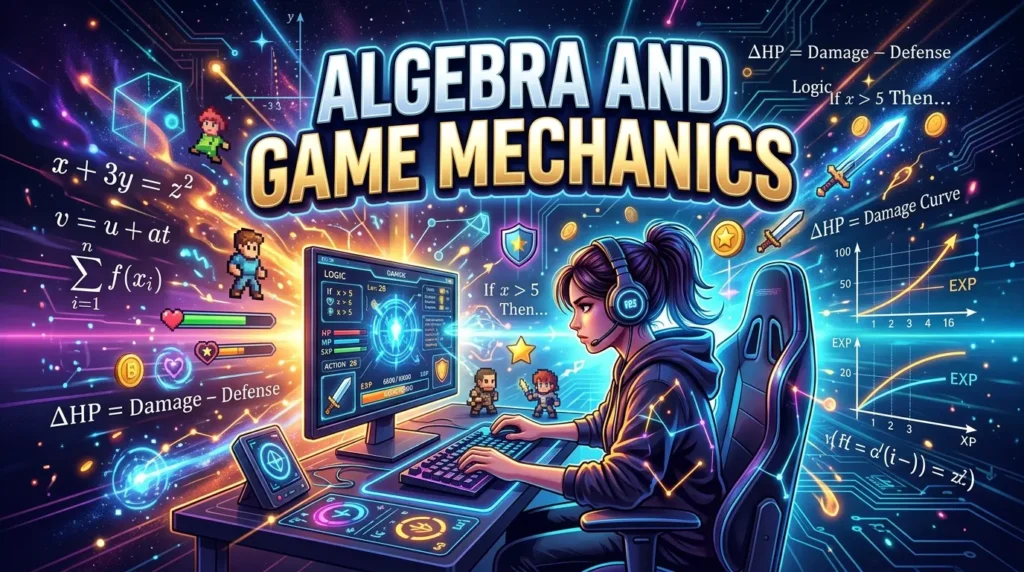
Algebra helps developers create flexible game systems using variables, formulas, and relationships between different values. Instead of manually calculating every possible situation, developers can use equations to create rules that work automatically.
Consider a simple damage formula:
Final Damage = Base Damage × Attack Multiplier − Defense
This type of formula allows the game to calculate damage based on the current abilities and equipment of different players or characters.
Algebra is also used for experience systems. A game may require increasing amounts of experience points for each new level. Developers can create formulas that automatically calculate the required experience.
For example:
Experience Required = Level × 100
A more advanced game may use a larger formula to make higher levels increasingly difficult.
Variables are everywhere in games. Health, speed, money, ammunition, energy, strength, and time can all be stored as variables. Developers then use mathematical operations to change these values.
Algebra also helps balance gameplay. Developers can test different formulas to determine whether rewards, enemy difficulty, or character abilities feel fair.
Players often encounter algebraic thinking when comparing equipment or calculating the best upgrade. They may ask which weapon produces more damage over time or which item provides the best value.
Because game mechanics depend heavily on changing values and relationships, algebra is one of the most practical areas of mathematics in gaming.
Probability and Random Events in Games
Probability controls uncertainty and random outcomes in many games. Random rewards, critical hits, loot drops, card draws, and enemy behavior can all use probability systems.
For example, imagine a rare item has a 5% chance of appearing. The game uses a random process to determine whether the player receives the item.
Probability can create excitement because players do not always know what will happen next. However, developers must design these systems carefully. Poor probability balance can make rewards feel unfair or frustrating.
Common gaming features that use probability include:
- Critical hit chances
- Loot drops
- Random item rewards
- Card draws
- Enemy spawn systems
- Procedural events
- Random maps
- Treasure rewards
- Chance-based abilities
- Competitive matchmaking factors
Probability is also useful for game balancing. Developers can simulate thousands or millions of outcomes to study whether a reward system behaves as expected.
Players can use probability to make better decisions. If one strategy has a higher chance of success, understanding the numbers can improve decision-making.
Probability does not always guarantee a specific outcome. A 50% chance does not mean success must happen every second attempt. Each event can still produce different results depending on how the game system works.
Understanding probability helps both developers and players recognize the difference between chance, expectation, and guaranteed results.
Statistics and Player Performance
Statistics help developers understand how players interact with games. They can collect and analyze information such as win rates, average playtime, weapon usage, completion rates, and player behavior.
This information can reveal important patterns. For example, if one character has a much higher win rate than others, developers may investigate whether that character is too powerful.
Common gaming statistics include:
- Win percentage
- Kill-to-death ratio
- Average score
- Accuracy percentage
- Damage per second
- Completion rate
- Average session time
- Player retention
- Ranking performance
- Resource usage
Statistics are especially important in competitive games. Ranking systems often analyze player performance to create fairer matches. Developers may also use statistical data to identify cheating, technical problems, or unbalanced mechanics.
Players use statistics to improve their own performance. A player might examine accuracy, reaction time, or win rate to identify weaknesses.
Statistics can also help gaming communities compare strategies. Large amounts of gameplay data can show which approaches perform well over time.
However, statistics must be interpreted carefully. A single number does not always explain the complete situation. Context, player skill, game mode, and sample size can affect the results.
When used correctly, statistics transform raw gameplay data into useful information for developers, competitive players, and gaming communities.
Calculus and Realistic Game Physics
Calculus can help create realistic movement and physical behavior in advanced games. Concepts related to change, motion, velocity, and acceleration are particularly useful.
Velocity describes how quickly an object’s position changes. Acceleration describes how quickly velocity changes. These concepts are important in racing games, flight simulators, sports games, and physics-based adventures.
Imagine a racing car accelerating from a starting position. The game must continuously update its speed and location. Mathematical calculations allow the car to move smoothly rather than instantly jumping from one position to another.
Calculus-related concepts can support:
- Vehicle movement
- Falling objects
- Projectile motion
- Acceleration
- Deceleration
- Camera movement
- Fluid simulation
- Character motion
A game does not always need advanced calculus for every feature. Many game engines provide physics tools that handle complex calculations automatically. However, the mathematical principles still influence how those systems work.
Developers can adjust values such as gravity, friction, mass, and force to create different experiences. A realistic simulation may use values close to real-world behavior, while an arcade game may intentionally use exaggerated physics.
Calculus and physics mathematics allow developers to simulate continuous change over time. This creates smoother, more believable, and more responsive gameplay.
Trigonometry for Angles and Direction
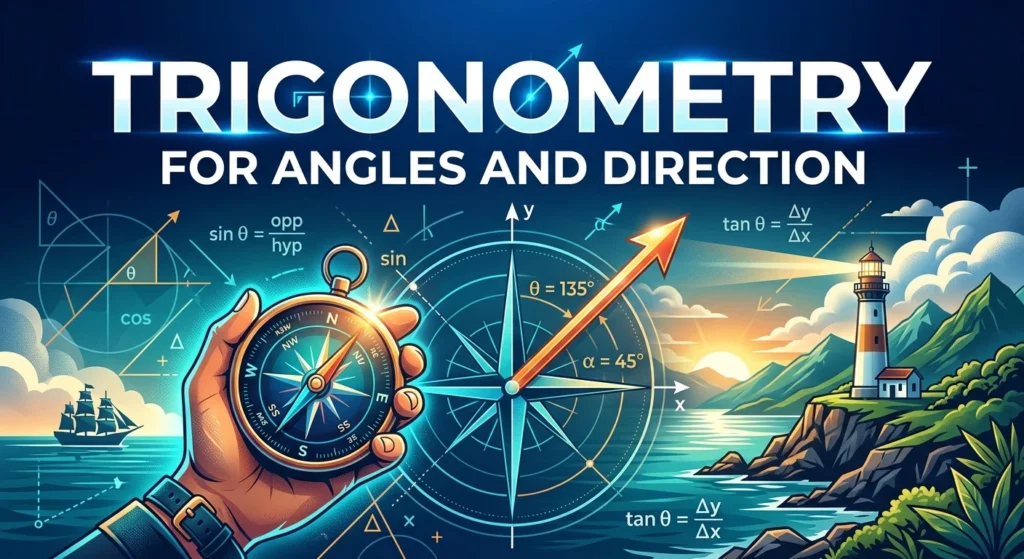
Trigonometry is extremely useful in games because digital environments often require calculations involving angles, rotation, distance, and direction.
Sine, cosine, and tangent can help determine positions and movement paths. These functions are particularly useful when an object moves or rotates around another point.
For example, imagine an enemy moving in a circular path around a player. The game can use trigonometric functions to calculate the enemy’s changing position.
Trigonometry is commonly used for:
- Character rotation
- Camera movement
- Projectile direction
- Circular motion
- Wave effects
- Lighting calculations
- Enemy tracking
- Terrain calculations
- Animation
- Field-of-view systems
Shooting games also use angles to determine where a weapon is aimed. Racing games calculate turning directions and vehicle orientation. Sports games can use trigonometry to model trajectories.
Trigonometry helps transform simple numerical values into natural-looking movement. Instead of manually programming every possible position, developers can use mathematical functions that automatically calculate continuous motion.
Players may also use practical trigonometric thinking without writing equations. Estimating angles, distances, and movement paths can improve aim and positioning.
As game worlds become more complex, trigonometry continues to provide important tools for movement, graphics, animation, and gameplay systems.
Mathematics in 2D and 3D Graphics
Modern video game graphics depend heavily on mathematics. A 3D game must convert mathematical information into the images displayed on a player’s screen.
Every object in a virtual world has information about its position, size, shape, and rotation. Mathematical transformations allow developers to move and manipulate these objects.
Common transformations include:
- Translation
- Rotation
- Scaling
- Projection
Translation moves an object from one location to another. Rotation changes its orientation. Scaling changes its size.
A 3D game also needs projection mathematics to display a three-dimensional world on a two-dimensional screen. Perspective projection helps objects appear smaller when they are farther away, creating a sense of depth.
Mathematical matrices are widely used in graphics programming to perform transformations efficiently. A game engine can combine multiple transformations to position an object correctly.
Lighting also involves mathematics. The game calculates how light interacts with surfaces, directions, shadows, and materials. These calculations help create realistic or stylized visual effects.
Although players usually see only the final image, thousands or millions of mathematical calculations may occur during gameplay. Graphics mathematics makes it possible to create detailed environments, animated characters, realistic lighting, and immersive virtual worlds.
Physics Engines and Mathematical Simulation
Physics engines use mathematical models to simulate how objects interact. They help games create believable movement, collisions, gravity, and forces.
When a ball hits a wall, the physics system can calculate its new direction and speed. When a character jumps, the game applies gravity to bring the character back to the ground.
Important physics concepts include mass, velocity, acceleration, force, friction, and momentum.
A simplified relationship between force and acceleration is:
Force = Mass × Acceleration
Game developers can use mathematical models based on these principles to create different gameplay experiences.
A realistic racing simulation may carefully model tire friction and vehicle weight. An arcade racing game may simplify the calculations to make driving easier and more exciting.
Physics engines can simulate:
- Falling objects
- Explosions
- Vehicle movement
- Character jumps
- Water effects
- Collisions
- Ragdoll animations
- Projectile paths
- Destructible environments
- Object interactions
Developers must balance realism with performance. Highly detailed simulations require more processing power. A game therefore uses mathematical approximations that provide believable results without slowing down the system.
Physics mathematics adds interaction to virtual worlds. Instead of objects simply moving through predefined animations, they can respond dynamically to player actions and environmental changes.
Mathematics Behind Artificial Intelligence in Gaming
Artificial intelligence in gaming uses mathematical and logical systems to control non-player characters and create responsive behavior.
An enemy must decide where to move, when to attack, and how to respond to the player’s actions. Developers can use algorithms, decision systems, probability, and mathematical scoring to guide these choices.
Pathfinding is a major example. A character may need to find an efficient route from one location to another while avoiding obstacles. Mathematical algorithms evaluate possible paths and select suitable routes.
Game AI can also use numerical values to evaluate decisions. For example, an enemy may assign scores to possible actions:
Attack = 80 points Hide = 50 points Retreat = 90 points
The AI can choose the action with the highest score based on the current situation.
Mathematics also supports:
- Enemy behavior
- Navigation
- Difficulty adjustment
- Strategic decisions
- Resource management
- Pattern recognition
- Player behavior analysis
- Procedural systems
Advanced games may use machine learning techniques, which rely heavily on statistics, optimization, and mathematical models.
The goal of game AI is not always to create the smartest possible opponent. Developers often design AI that creates enjoyable challenges. Mathematics helps control difficulty and behavior so that the game feels challenging without becoming unfair.
Game Economics and Resource Management
Many games contain virtual economies, and mathematics helps control how those systems operate. Players may earn currency, purchase items, upgrade characters, or manage limited resources.
Developers must carefully balance income and spending. If players earn money too quickly, valuable items may lose their importance. If earning rewards takes too long, players may become frustrated.
Mathematical models help developers determine:
- Item prices
- Reward values
- Upgrade costs
- Resource generation
- Economic inflation
- Trading values
- Progression speed
- Experience rewards
- Risk and reward balance
- Resource scarcity
Strategy and simulation games often require players to perform their own calculations. Players may compare the cost of different units, estimate production time, or calculate the most efficient use of resources.
For example, if one building costs 500 resources and generates 100 resources every minute, a player can estimate how long it will take to recover the original investment.
Game economics can also teach useful real-world concepts such as budgeting, opportunity cost, efficiency, and investment.
A well-designed virtual economy creates meaningful decisions. Mathematics helps ensure that rewards, costs, and progression work together in a balanced and understandable system.
Algorithms and Procedural Game Generation
Algorithms allow developers to create rules that solve problems or generate content. In gaming, algorithms can control everything from enemy movement to world generation.
Procedural generation uses mathematical rules and algorithms to create content automatically. Instead of designing every mountain, room, or landscape by hand, developers can create systems that generate variations.
Procedural systems may create:
- Landscapes
- Dungeons
- Maps
- Buildings
- Missions
- Enemy placements
- Weather patterns
- Items
- Plants and environments
- Random events
Mathematics helps control randomness so that generated content remains useful and interesting. Pure randomness could create impossible or boring environments. Developers therefore combine random values with rules and constraints.
For example, a procedural map generator may ensure that important locations remain reachable while still creating a unique layout.
Algorithms also improve efficiency. A well-designed algorithm can solve a problem quickly, while an inefficient one may cause lag or poor performance.
Procedural generation demonstrates how mathematics and creativity can work together. A developer creates the rules, and the mathematical system produces many possible results. This can allow games to offer large or varied worlds without manually creating every detail.
Mathematics in Game Balancing
Game balancing is the process of adjusting systems so that gameplay feels fair, challenging, and enjoyable. Mathematics provides valuable tools for this task.
Developers must compare many variables. Characters may have different health, speed, damage, abilities, and cooldown times. A small numerical change can significantly affect gameplay.
For example, damage alone may not show how powerful a weapon is. Developers may also consider firing speed.
A simple concept is:
Damage Per Second = Damage per Shot × Shots per Second
This provides a clearer way to compare weapons.
Developers can use mathematical models and gameplay data to study balance. They may examine win rates, average damage, pick rates, and other statistics.
Balance also involves player perception. Two options may be mathematically equal but still feel different because of difficulty, timing, or risk.
Mathematical balancing can help with:
- Weapon strength
- Character abilities
- Enemy difficulty
- Reward systems
- Level progression
- Resource costs
- Competitive fairness
- Risk and reward
- Game pacing
- Multiplayer matchmaking
Testing is essential because formulas alone cannot guarantee a fun experience. Developers combine mathematical analysis with player feedback and practical gameplay testing.
Effective game balancing creates meaningful choices. Players should feel that different strategies can work while still requiring skill, planning, and adaptation.
Mathematics in Competitive Gaming and Esports
Competitive gaming often involves constant mathematical decision-making. Professional and skilled players analyze statistics, timing, probabilities, damage values, and resource management.
In a competitive match, a player may calculate whether an ability will defeat an opponent, how long a cooldown will last, or whether taking a risk is worth the possible reward.
Mathematics supports competitive gaming through:
- Performance statistics
- Ranking systems
- Match analysis
- Damage calculations
- Resource efficiency
- Timing strategies
- Probability analysis
- Team composition
- Economy management
- Performance prediction
Teams may also analyze large amounts of gameplay data. Coaches and analysts can study patterns to identify successful strategies or weaknesses.
For example, a team may discover that a particular strategy produces better results under specific conditions. Statistical analysis can help separate useful patterns from random results.
Players also benefit from understanding percentages and ratios. Accuracy rates, win rates, critical hit chances, and resource efficiency can influence strategic decisions.
Mathematics does not replace mechanical skill or creativity. Instead, it provides additional information that can support better choices.
In esports, small numerical advantages can matter. Understanding game systems, timing, and probabilities can help players make smarter decisions under pressure.
How Mathematics Improves the Player Experience
Mathematics improves gaming by creating systems that are consistent, responsive, and meaningful. Players may not see the formulas, but they experience the results.
Smooth movement depends on calculations that update a character’s position. Realistic environments depend on geometry and graphics mathematics. Fair competition depends on statistics and balancing systems.
Mathematics also supports personalization. A game can adjust difficulty based on player performance or use data to create suitable challenges.
Well-designed mathematical systems can improve:
- Game responsiveness
- Visual quality
- Difficulty balance
- Fair competition
- Character progression
- Reward systems
- Realistic movement
- Strategic depth
- Replay value
- Overall player satisfaction
The best mathematical systems usually feel natural. Players should focus on enjoying the game rather than noticing every calculation.
However, transparent numbers can also improve the player experience in strategy and role-playing games. Clear information allows players to make informed decisions and experiment with different approaches.
Mathematics creates structure, while game design adds creativity and emotion. Together, they transform numerical rules into exciting experiences.
How Students Can Learn Mathematics Through Gaming
Gaming can make mathematical concepts more practical and engaging for students. Instead of seeing mathematics only as equations on paper, students can explore how numbers influence movement, strategy, probability, and decision-making.
Puzzle games can develop logical thinking and pattern recognition. Strategy games can introduce resource management and optimization. Simulation games may involve budgeting, growth, and planning.
Students can also learn mathematics by creating simple games. A basic project might involve calculating scores, moving objects with coordinates, or creating random events.
Useful learning activities include:
- Calculating game scores
- Measuring movement speed
- Designing probability systems
- Creating simple physics simulations
- Comparing statistical performance
- Building coordinate-based games
- Balancing game mechanics
- Analyzing player data
- Designing virtual economies
- Programming mathematical formulas
Game development can provide a practical reason to learn concepts that may otherwise seem abstract.
For example, a student learning trigonometry may better understand angles when using them to rotate an object toward a target. A student studying probability may enjoy designing a fair loot system.
Gaming should not replace traditional learning, but it can provide an engaging application for mathematical knowledge. By connecting mathematics with interactive experiences, students can better understand why mathematical skills are useful.
Future Trends for Mathematics in Gaming
The future of mathematics in gaming will likely become even more important as technology continues to advance. More realistic simulations, intelligent systems, and large virtual environments require sophisticated calculations.
Artificial intelligence may create more adaptive game characters and personalized experiences. Mathematical optimization can help developers improve performance while maintaining high-quality graphics.
Procedural generation may create increasingly complex worlds using algorithms and mathematical rules. Physics simulations may become more detailed, creating more realistic interactions.
Important future areas may include:
- Advanced artificial intelligence
- Machine learning
- Real-time simulation
- Procedural content generation
- Virtual reality
- Augmented reality
- Cloud gaming optimization
- Advanced graphics rendering
- Personalized gameplay
- Large-scale virtual worlds
As hardware becomes more powerful, developers can use increasingly complex mathematical models. However, efficiency will remain important because games must balance visual quality, realism, responsiveness, and performance.
Mathematics will continue to support innovation while giving developers tools to transform creative ideas into functional systems.
The future of gaming is not based only on better graphics. It also depends on better mathematical models, algorithms, and computational methods working behind every interactive experience.
Practical Examples of Mathematics in Gaming
Mathematics appears in everyday gameplay in many simple and advanced ways. Recognizing these examples can help players understand how game systems work.
Here are 20 practical examples:
- A racing game calculates vehicle speed and acceleration.
- A shooting game calculates bullet direction and distance.
- A platform game uses coordinates for character movement.
- A role-playing game calculates damage using formulas.
- A strategy game compares resource costs and production rates.
- A sports game calculates ball movement and trajectories.
- A puzzle game uses patterns and logical relationships.
- A loot system uses probability to determine rewards.
- A multiplayer game uses statistics for player rankings.
- A physics game calculates gravity and collisions.
- A 3D game uses geometry to build objects and environments.
- A game camera uses angles and transformations.
- Enemy AI calculates possible movement paths.
- A virtual economy calculates prices and rewards.
- Procedural maps use algorithms and controlled randomness.
- Character upgrades use numerical progression systems.
- Matchmaking systems compare player performance data.
- Animation systems calculate positions and transitions.
- Lighting systems use mathematical models for visual effects.
- Esports players analyze percentages, timing, and performance statistics.
These examples show that mathematics is present across nearly every genre of gaming.
Conclusion
Mathematics in gaming is much more than simple addition or scorekeeping. It supports movement, graphics, physics, artificial intelligence, probability, statistics, game balancing, and competitive strategy. Every time a character moves across a virtual world, a projectile follows a path, or a player receives a random reward, mathematical systems are working behind the scenes.
For developers, mathematics provides the tools needed to build reliable and interactive game systems. For players, mathematical thinking can improve strategy, resource management, and decision-making.
As gaming technology continues to evolve, the connection between mathematics and game development will become even stronger. Learning the mathematical foundations of gaming can therefore open the door to a deeper understanding of both technology and interactive entertainment.
FAQs
1. Why is mathematics important in gaming?
Mathematics is important in gaming because it supports movement, graphics, physics, artificial intelligence, probability, scoring, and game balancing. Developers use mathematical formulas and algorithms to create interactive and responsive game experiences.
2. What type of mathematics is used in game development?
Game development uses algebra, geometry, trigonometry, calculus, probability, statistics, and algorithms. Different areas of mathematics support different parts of a game, such as graphics, physics, artificial intelligence, and player progression.
3. Is mathematics required to become a game developer?
Basic mathematical knowledge is very helpful for game development. The amount of mathematics required depends on the role. Programmers working with graphics, physics, or game engines may use more advanced mathematics than designers or writers.
4. How is probability used in video games?
Probability is used for random events such as loot drops, critical hits, card draws, rewards, and enemy behavior. Developers use probability systems to create uncertainty while maintaining control over game balance.
5. Can playing games help improve mathematics skills?
Some games can support mathematical thinking by encouraging problem-solving, pattern recognition, probability analysis, resource management, and strategic planning. Creating games can also provide practical experience with mathematical concepts.