Zeebo Gaming is an interesting topic for anyone who wants to learn about gaming platforms, interactive entertainment, and the history of video games. The Zeebo was designed as a dedicated gaming system with a different approach from traditional consoles. It focused on digital game distribution and aimed to make gaming more accessible in emerging markets.
Its unique concept helped it stand apart from better-known gaming systems of its time. For gamers and gaming enthusiasts, learning about Zeebo can offer useful insight into how gaming technology and digital distribution have changed over the years. In this article, we will explore Zeebo Gaming, its concept, key features, games, and its place in gaming history.
What Is Zeebo Gaming?
Zeebo gaming refers to playing games through the Zeebo entertainment console, a platform created with a strong focus on digital game distribution and internet connectivity.
Unlike traditional consoles that depended heavily on physical discs or cartridges, the Zeebo was designed around downloadable content. Players could access games through the system’s digital network, making the platform different from many consoles available during its era.
The concept was particularly notable because Zeebo targeted markets where traditional gaming hardware and physical game distribution could be expensive or difficult to access. The system aimed to provide a more affordable and accessible gaming experience.
Zeebo also combined gaming with connected entertainment features. Its design reflected an early attempt to make online connectivity part of the core console experience.
The platform did not achieve the global success of major systems from companies such as Nintendo, Sony, and Microsoft. However, it remains an interesting part of gaming history because it explored ideas that later became much more common.
Modern consoles now rely heavily on digital storefronts, downloadable games, online services, and connected accounts. Zeebo experimented with several related concepts at an earlier stage.
For gaming historians and retro enthusiasts, Zeebo gaming offers an example of how companies tried to rethink the traditional console model.
It also demonstrates that successful gaming hardware requires more than interesting technology. Strong game libraries, pricing, marketing, developer support, and long-term customer confidence all play major roles.
The History Behind Zeebo Gaming
The Zeebo project emerged during a period when the gaming industry was rapidly changing. Broadband internet was becoming more common, digital distribution was developing, and companies were exploring ways to reach new gaming audiences.
The Zeebo platform was developed by Zeebo Inc., with the project associated with technology and business partnerships involving companies such as Qualcomm and Tectoy.
The system was first introduced in Brazil, which became an important market for the platform. It later expanded into other countries, including Mexico.
The company’s strategy focused on making digital gaming accessible without depending on traditional physical media. That approach was particularly interesting in markets where piracy and the cost of physical games presented significant challenges.
Instead of purchasing discs from traditional retail stores, users could obtain games digitally through the Zeebo network.
The platform also attempted to provide a controlled digital ecosystem. This approach allowed the company to manage game distribution and create a more direct relationship between the platform and its users.
However, the gaming industry is highly competitive. Consumers often choose platforms based on recognizable brands, exclusive games, hardware capabilities, online communities, and long-term support.
Zeebo faced competition from established consoles with larger libraries and stronger international recognition.
The platform eventually ceased operations, but its history remains useful for understanding the development of digital gaming.
Its story shows how experimental console ideas can influence broader discussions about accessibility, digital distribution, and connected entertainment.
Zeebo Gaming Hardware and Design
The Zeebo console was designed to provide a relatively simple gaming experience without relying on an optical disc drive.
Its hardware architecture was based on technology intended to support affordable digital gaming. The system was much smaller and simpler than some of the more powerful consoles competing in the same period.
The absence of a conventional disc drive was one of its most notable design choices. Instead, games were delivered digitally through the platform’s network.
This design helped support the company’s strategy of controlling digital distribution and reducing dependence on physical media.
The console also included connectivity features that were central to its concept. Network access allowed users to obtain games and interact with the platform’s digital services.
From a historical perspective, this is particularly interesting because digital-first consoles were not yet the standard approach when Zeebo launched.
Modern gamers are accustomed to downloading games directly to consoles, but the concept was less established at the time.
The Zeebo’s hardware was not intended to compete directly with high-end gaming PCs or the most powerful consoles. Its goal was to provide a simpler and more accessible platform.
That distinction is important when evaluating the system today.
Judging Zeebo only by modern hardware standards would miss the reason the platform existed. Its importance comes partly from the problems it attempted to solve through affordable hardware and digital distribution.
The system therefore represents an interesting experiment in console design and market accessibility.
How Zeebo Digital Gaming Worked
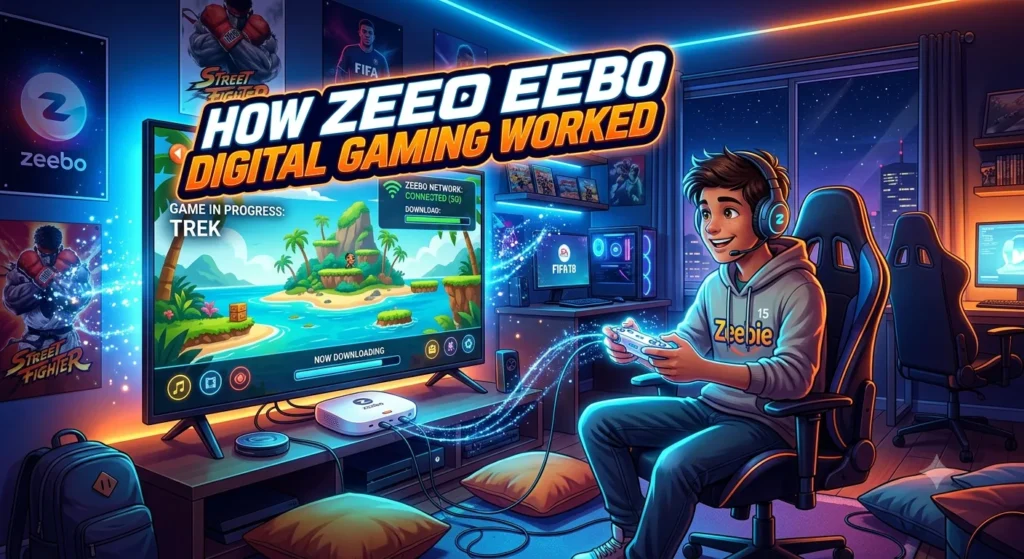
Digital distribution was one of the defining characteristics of Zeebo gaming.
Instead of inserting a physical game disc, users could obtain games through the console’s connected network. This made the platform fundamentally different from traditional retail-focused consoles.
The approach had several potential advantages. Digital distribution could reduce the need for physical manufacturing, shipping, packaging, and retail inventory.
It could also give the platform operator greater control over pricing and availability.
For users, downloading games meant they did not need to maintain a collection of physical discs. Games could remain associated with the digital ecosystem rather than individual pieces of physical media.
The model also attempted to address piracy concerns. Traditional physical games can be copied and distributed illegally, while a controlled digital platform can implement different protections.
However, digital distribution also creates challenges. Users depend on the platform’s servers, network infrastructure, and account systems.
If a company stops supporting its digital storefront, access to previously available content can become complicated.
This issue has become increasingly important as modern gaming moves further toward digital ownership.
Zeebo’s approach therefore provides an early example of both the benefits and risks associated with digital-first gaming.
Its model was ahead of some industry trends but also depended heavily on maintaining a functioning digital ecosystem.
Zeebo Gaming Library
A gaming platform ultimately depends heavily on its game library. Hardware can be innovative, but players need appealing software to keep using the system.
The Zeebo library included a variety of titles, with games designed to work within the platform’s hardware capabilities and digital distribution model.
The library included adaptations, recognizable franchises, and games aimed at casual and mainstream audiences.
Some titles were associated with established gaming brands, which helped give the platform greater visibility.
The overall library was much smaller than those of major consoles from Nintendo, Sony, and Microsoft. This limited selection was one of the challenges facing the platform.
Gamers often compare consoles based on exclusive games and the number of titles available. A smaller library can make it harder for a platform to attract new customers.
However, game quantity is not the only factor that matters. A smaller platform can still succeed if it has a strong selection of games that match its audience.
Zeebo’s game library is now primarily interesting from a historical and preservation perspective.
Retro gaming enthusiasts may explore its titles to understand what the platform offered and how developers adapted games to its hardware.
The library also illustrates how developers and publishers experimented with alternative distribution systems.
For researchers and gaming historians, Zeebo games can provide insight into the industry’s transition from physical media toward digital delivery.
Popular Zeebo Games
Several recognizable games were associated with the Zeebo platform, helping demonstrate its ability to attract established gaming properties.
The exact availability of games varied by region and over the platform’s lifetime, so historical lists should be treated carefully.
Among the better-known titles associated with Zeebo were Resident Evil 4, Crash Bandicoot Nitro Kart 3D, and Tekken 2, alongside other games adapted for the platform.
The presence of recognizable franchises was important because familiar game names can help consumers trust an unfamiliar console.
For a new platform, having known franchises can also make marketing easier. Players may be more willing to investigate a new system when they recognize some of its games.
At the same time, ports and adaptations must work within the hardware limitations of the target platform. Developers may need to adjust graphics, controls, performance, or other technical elements.
This makes Zeebo’s software library interesting from a development perspective.
The platform shows how game companies can adapt existing intellectual properties for different hardware and audiences.
Retro enthusiasts interested in Zeebo gaming should remember that the original digital storefront and services are no longer equivalent to a modern active console ecosystem.
Consequently, exploring the platform today may require historical research, preserved hardware, documentation, and legitimate preservation resources.
Its games remain an important part of the platform’s story even though the original commercial environment has ended.
Zeebo Gaming and Emerging Markets
One of the most important aspects of Zeebo gaming was its focus on emerging markets.
Traditional gaming hardware can become expensive when import costs, taxes, retail margins, and physical game prices are added together.
Zeebo attempted to address some of these barriers by using a digital distribution model and targeting regions where mainstream console gaming could be less accessible.
Brazil was particularly important to the platform’s launch and identity.
This strategy reflected a broader question in the gaming industry: how can companies create products for audiences that are underserved by conventional gaming business models?
The answer is not simply to make cheaper hardware. Companies must also consider local infrastructure, pricing, payment systems, content preferences, language, marketing, and customer support.
Zeebo’s experiment is therefore useful beyond its own history.
It demonstrated that emerging markets can require different approaches to gaming distribution. The needs of a player in one country may differ considerably from those of a player in another.
The platform’s experience also highlights the importance of local market knowledge.
Although Zeebo did not become a global gaming giant, its focus on accessibility remains noteworthy.
Modern gaming companies continue to explore lower-cost hardware, cloud gaming, mobile gaming, subscription services, and digital distribution to reach wider audiences.
In that sense, Zeebo’s market strategy remains relevant when discussing the future of accessible gaming.
Zeebo Gaming Controller
The controller is an important part of any console experience, and Zeebo used a traditional gamepad-style approach for its main gaming controls.
The controller provided familiar buttons and controls for navigating games.
A familiar controller layout can reduce the learning curve for players who have experience with other gaming systems.
For developers, controller compatibility also helps create a consistent control system across different titles.
Because Zeebo games could include different genres, developers had to adapt controls to racing games, action games, platformers, and other experiences.
The controller was part of the platform’s attempt to provide a recognizable console experience despite its unusual digital-first model.
For modern retro collectors, original controllers can be an important part of the hardware experience.
However, older controllers may suffer from wear, including button problems, cable damage, or reduced responsiveness.
Anyone purchasing vintage hardware should inspect the controller carefully and verify compatibility before attempting repairs or modifications.
The controller also demonstrates that innovation does not always require completely new input technology.
Zeebo’s major innovation was more strongly connected to distribution, connectivity, and market strategy than to radically changing how players controlled games.
This combination of familiar controls and unconventional distribution helped make the platform approachable for users who already understood traditional console gaming.
Zeebo Gaming Graphics and Performance
The Zeebo was designed for a specific level of gaming performance rather than competing directly with high-end contemporary hardware.
Its games were developed or adapted to work within the system’s technical limitations.
This meant that players should not expect the graphical quality associated with more powerful consoles or modern gaming PCs.
However, graphics are only one part of the gaming experience.
Game design, controls, sound, pacing, and overall enjoyment can remain important even when hardware is less powerful.
The platform’s technical limitations also created interesting challenges for developers. Games had to be optimized for the available processing and graphical resources.
This can involve reducing texture complexity, adjusting visual effects, simplifying environments, or optimizing performance.
From a historical perspective, such limitations can make older platforms interesting to study.
Developers working with constrained hardware often find creative solutions to deliver playable experiences.
Modern gamers may view Zeebo graphics as dated, but that comparison should be placed within the system’s original context.
The platform was built around affordability and accessibility rather than maximum graphical performance.
Its technical design reflects a particular period in gaming history when companies were experimenting with alternative hardware and distribution models.
For retro enthusiasts, the visual style can even become part of the appeal.
Zeebo Gaming Online Connectivity
Connectivity was central to the Zeebo concept. The platform was designed around network access and digital content rather than treating online features as an optional addition.
This was significant because connected gaming was becoming increasingly important during the era when Zeebo launched.
Digital connectivity allowed users to access games through the platform’s distribution system.
The approach created a more integrated relationship between hardware, software, and online services.
This model has become extremely common today. Modern consoles rely on digital stores, account systems, online updates, downloadable content, and network services.
Zeebo therefore provides an interesting historical example of an early connected-console strategy.
However, connected platforms have an important weakness: they depend on continued service support.
When a company shuts down servers or digital stores, certain features may no longer function.
This creates challenges for game preservation and digital ownership.
Retro gamers who study older online-dependent systems can see why preservation is becoming an important topic within the gaming community.
Zeebo’s history demonstrates that a console can become difficult to use in its original form when its supporting infrastructure disappears.
The lesson remains relevant today as modern platforms become increasingly dependent on online services.
Digital convenience can be powerful, but long-term access depends partly on the companies operating those services.
Advantages of Zeebo Gaming
Zeebo gaming had several interesting advantages when viewed in the context of its original market.
The digital-first distribution model was one of its biggest strengths. It provided an alternative to traditional physical game retail and could help reduce certain barriers associated with physical products.
The platform also had a relatively straightforward concept. Users could access games through a connected system rather than managing physical media.
Its focus on emerging markets was another important strength. Zeebo attempted to serve customers who were not necessarily well served by traditional console business models.
The hardware also represented a different approach to affordability.
Another advantage was the opportunity to work with recognizable game properties. Familiar titles could make the platform more attractive to potential customers.
From a historical viewpoint, Zeebo also deserves credit for experimenting with ideas that later became more common.
Digital storefronts, downloadable games, connected consoles, and online account ecosystems are now standard features across the industry.
Zeebo demonstrated that these concepts could be incorporated into a gaming platform designed specifically around digital access.
Of course, these advantages existed alongside major limitations.
The platform’s smaller library, limited market reach, and dependence on network services affected its long-term success.
Still, evaluating Zeebo only as a commercial success or failure misses its experimental value.
Its most interesting contribution may have been showing how alternative gaming distribution could work in markets outside the traditional console model.
Limitations of Zeebo Gaming
Understanding Zeebo’s limitations helps explain why the platform did not become a major global competitor.
The most obvious challenge was competition. Established consoles had larger libraries, stronger brands, extensive developer relationships, and large international communities.
Zeebo had to convince consumers to choose a less established platform.
The size of its game library was another challenge. Players often want access to a wide selection of genres and franchises, and a smaller library can make a console harder to justify.
Hardware capabilities also limited the platform’s ability to compete with more powerful gaming systems.
Another issue was dependence on digital infrastructure. Because the platform relied heavily on connected services, long-term functionality depended on the continued operation of its network.
This is a common challenge for digital-first systems.
Marketing and regional availability also influenced its reach. A product can have an interesting concept but still struggle if consumers are unfamiliar with it or cannot easily purchase it.
The platform’s business model also needed enough revenue to support hardware, software, network infrastructure, and developer relationships.
These challenges illustrate the difficulty of launching a new gaming platform.
Successful consoles require more than affordable hardware. They need a strong ecosystem that includes compelling games, reliable services, competitive pricing, developers, retailers or digital distribution, and a large enough user base.
Zeebo’s experience offers a valuable lesson in how difficult it is to compete in the console market.
Zeebo Gaming Compared With Modern Consoles
Modern gaming consoles operate on a much larger scale than Zeebo did, but some of their core concepts share similarities with the earlier platform.
Digital game purchases are now normal. Players can download games directly to consoles without visiting a physical retailer.
Online updates are also standard. Modern games frequently receive patches, additional content, and system updates through internet connections.
Digital accounts and online storefronts have become central parts of console ecosystems.
These developments make some aspects of Zeebo’s approach seem surprisingly familiar.
However, modern consoles typically offer much greater hardware performance, larger game libraries, advanced graphics, sophisticated online services, and stronger global infrastructure.
Modern platforms also benefit from much faster internet connections and more mature digital payment systems.
Mobile gaming has expanded the concept of accessible digital gaming even further.
Cloud gaming and subscription services have also created new approaches to game distribution.
Zeebo therefore occupies an interesting position in gaming history. It was not the first connected gaming system, but its particular combination of affordability, digital distribution, and emerging-market focus made it distinctive.
Comparing it with modern consoles should therefore focus on ideas rather than raw hardware specifications.
The platform demonstrates how gaming evolves through experimentation.
Some ideas disappear, while others become standard features of the industry.
Zeebo’s digital-first strategy can be viewed as one small part of the broader transition from physical gaming toward connected digital ecosystems.
Is Zeebo Gaming Still Relevant Today?
Although the original Zeebo platform is no longer an active mainstream gaming system, it remains relevant for several reasons.
First, it represents an important experiment in digital game distribution.
Second, its focus on emerging markets provides useful insight into accessibility and regional gaming economics.
Third, it helps demonstrate how connected gaming systems can depend on online infrastructure.
For retro gaming enthusiasts, the Zeebo is also an example of a lesser-known console that deserves preservation and historical documentation.
Collectors may be interested in original hardware, controllers, packaging, and games.
Researchers can also study the platform’s business strategy and technology to understand how gaming companies experimented with alternative models.
The system’s relevance does not mean it should be treated as a modern alternative to current consoles. Modern platforms provide far greater performance, support, and software availability.
Instead, Zeebo is valuable as a historical case study.
Its story raises questions that remain relevant today.
What happens when a platform depends heavily on online infrastructure?
These questions continue to affect the gaming industry.
For that reason, Zeebo gaming remains more than an obscure console name. It represents an interesting experiment in how games could be distributed and experienced outside the traditional console market.
The Legacy of Zeebo Gaming
The legacy of Zeebo is not based on becoming one of the world’s most successful consoles. Instead, its importance comes from the ideas it explored.
The platform challenged the traditional assumption that console games needed physical media.
It also emphasized connectivity and digital distribution at a time when those ideas were still developing.
Its focus on emerging markets demonstrated that gaming companies could design different strategies for audiences outside the largest traditional gaming markets.
The platform also highlights the risks associated with digital ecosystems.
When a connected service disappears, access to certain software or features can become difficult. This issue has become increasingly important as the modern gaming industry moves toward digital ownership.
Zeebo’s history can therefore contribute to conversations about game preservation and digital rights.
Developers and industry researchers, the platform provides an example of experimentation under hardware and market constraints.
For retro gamers, it offers something different from mainstream console collecting.
For students of gaming history, it provides a case study in business strategy, technology, distribution, and accessibility.
The Zeebo may not have transformed the industry by itself, but its ideas appeared during a period of major transition.
That makes it worth remembering.
Gaming history is not only about the biggest consoles. Smaller and unsuccessful platforms can also reveal important lessons about what works, what fails, and how the industry changes over time.
Conclusion
Zeebo Gaming represents an interesting chapter in the history of video game consoles. Its focus on digital game distribution and accessible gaming gave it a different approach from many traditional systems. While the Zeebo did not become a major global gaming platform, its concept showed how console makers could explore new ways to deliver games to players. For gaming enthusiasts, learning about Zeebo can provide a better understanding of how the industry has changed over time. It also highlights the importance of accessibility, technology, and digital distribution in gaming. Whether you are interested in retro consoles or the evolution of gaming technology, Zeebo remains a unique platform worth exploring.
FAQs
What was Zeebo gaming?
Zeebo gaming refers to the gaming experience offered through the Zeebo console, a digital-focused entertainment platform designed with an emphasis on connected game distribution and emerging markets.
Was Zeebo a real gaming console?
Yes. Zeebo was a real dedicated gaming console. It was launched commercially and offered downloadable games through its connected digital platform.
What made Zeebo different from other consoles?
Its strong focus on digital game distribution and connectivity made it different from many traditional consoles of its era. It also targeted markets that were not always well served by conventional gaming systems.
Can you still play Zeebo games today?
The original Zeebo network and commercial ecosystem are no longer operating as they once did. Access to the platform today generally depends on preserved hardware, historical resources, and legitimate game-preservation efforts.
Why is Zeebo important in gaming history?
Zeebo is notable because it experimented with affordable connected gaming and digital distribution before those concepts became widespread across the modern gaming industry. Its history also provides useful lessons about digital ownership, accessibility, and platform support.