Meta gaming is one of the most interesting ideas in modern gaming because it goes beyond simply playing the rules of a game. It describes the strategies, choices, trends, and outside knowledge that influence how players approach a game. In competitive titles, the meta can shape which characters, weapons, decks, builds, or tactics players consider strongest. A game’s meta can change quickly when developers release balance updates, introduce new content, or when players discover better strategies.
Understanding meta gaming can help beginners learn faster and help experienced players make smarter decisions. Whether you play competitive shooters, strategy games, card games, MOBAs, RPGs, or multiplayer role-playing games, understanding the meta can give you a clearer view of how communities develop and why certain strategies become popular.
What Does Meta Gaming Mean?
Meta gaming generally refers to playing a game with an awareness of information, strategies, trends, or circumstances that exist beyond the immediate actions of the game itself. The word meta often describes the current environment surrounding a game rather than the basic rules alone.
For example, imagine a multiplayer game with ten playable characters. Players may discover that three characters perform especially well after a balance update. As more people use those characters, competitive players begin building strategies around them. This creates a game meta. Players who understand the current meta may select characters, equipment, or tactics based on what is currently considered effective.
Meta gaming can also have a different meaning in role-playing games. In tabletop or role-playing communities, metagaming may describe using information that a player knows but their character technically does not. A player might know about an enemy’s weakness from reading a guide, even though their fictional character has never encountered that enemy.
The meaning therefore depends on the gaming context. In competitive gaming, meta usually means the strongest or most popular strategies. In role-playing, metagaming can involve separating player knowledge from character knowledge. Both meanings are important when discussing how players interact with games.
How the Gaming Meta Develops
A gaming meta develops naturally as players experiment, share information, and discover efficient ways to win. Developers create the initial rules, but the player community often determines how those rules are used in practice.
When a new game launches, players usually experiment with different characters, weapons, strategies, and team compositions. At first, nobody completely understands which options are strongest. Over time, competitive players test different approaches and share their findings through videos, forums, livestreams, tournaments, and social media.
Statistics can also influence the process. If a particular weapon produces a higher win rate than similar weapons, players may begin using it more frequently. Professional players can accelerate this trend because thousands of regular players watch tournaments and copy successful strategies.
The meta can change whenever developers modify the game. A balance patch might reduce the power of an overused character or improve an unpopular weapon. Suddenly, strategies that dominated the previous meta may become less effective.
Community creativity is another major factor. Sometimes players discover unusual combinations that developers did not expect. A strategy that initially looks weak can become powerful when combined with the right team or equipment.
This constant cycle of experimentation makes gaming metas dynamic. There is rarely one permanent best strategy. Instead, the meta continues evolving as players and developers respond to each other.
Why Meta Gaming Matters in Competitive Games
Meta gaming matters greatly in competitive games because small advantages can influence the outcome of a match. When players compete at a high level, they usually look for reliable ways to improve their performance.
Understanding the current meta helps players recognize popular strategies before entering a match. If a particular character or weapon appears frequently, knowing how it works can make it easier to counter. Meta knowledge can therefore be useful even when a player does not personally use the strongest option.
Competitive games often involve a relationship between strategy, skill, and adaptation. Mechanical skill may help a player aim, move, or execute actions accurately, but strategic knowledge helps determine when and why those actions should happen.
The meta can also influence team building. In team-based games, players often select combinations that complement each other. A strong team composition may provide damage, defense, mobility, support, and control. Understanding these roles helps players create balanced teams instead of selecting characters randomly.
However, following the meta does not guarantee success. A player may choose a popular character without understanding its strengths and weaknesses. Another player using an unusual choice may perform better because they have greater experience with it.
For this reason, meta gaming should be viewed as a tool rather than a replacement for skill. The strongest players often combine knowledge of current trends with practice, communication, mechanical ability, and intelligent decision-making.
Meta Gaming in Multiplayer Games
Multiplayer games are especially influenced by meta gaming because players constantly compete against one another and share information. Popular multiplayer titles can develop complex strategies within weeks or even days.
Players usually notice patterns during matches. They may discover that certain weapons are effective at specific distances, particular characters work well together, or certain map positions provide a major advantage. Once these discoveries spread through the community, they become part of the meta.
Multiplayer games also create a feedback loop. A powerful strategy becomes popular, more players start using it, and opponents develop counters. The original strategy then becomes less dominant, encouraging players to search for another approach.
This process is particularly visible in competitive shooters, MOBAs, fighting games, real-time strategy games, and card games. Players often study patch notes, watch professional matches, and follow experienced creators to understand the latest developments.
Communication also plays an important role. A strategy that looks average when used by one player may become extremely effective when an entire team coordinates around it. This is why team-based meta gaming involves more than simply selecting the strongest individual option.
The best approach is to understand why a strategy works. Memorizing a popular build can help temporarily, but understanding its underlying strengths allows players to adapt when opponents respond.
Meta Gaming and Game Balance
Game balance and meta gaming are closely connected. Developers constantly attempt to create a fair environment where multiple choices remain useful rather than allowing one strategy to dominate everything.
When a particular character, weapon, card, or ability becomes overwhelmingly powerful, players often describe it as part of the dominant meta. If nearly everyone chooses the same option, the game can become predictable.
Developers may respond with balance changes. They can reduce damage, increase cooldowns, adjust health values, change abilities, or improve weaker options. These adjustments can completely reshape the competitive environment.
Balance does not necessarily mean every option must have identical power. Different choices can serve different purposes. A defensive character may be excellent in one situation but weaker in another. A weapon may have exceptional range but perform poorly in close combat.
Healthy meta gaming often comes from meaningful choices. Players should have multiple viable strategies and be encouraged to adapt to different situations.
Balance patches can also create excitement. A previously ignored character may suddenly become competitive after receiving improvements. Professional players then experiment with the character, and the community follows their discoveries.
For players, understanding balance changes is useful because yesterday’s strongest strategy may not remain effective forever. Reading patch notes and testing changes directly can provide a better understanding of the current game environment.
The Role of Meta Gaming in Esports
Esports provides one of the clearest examples of meta gaming. Professional players compete at extremely high levels, so teams constantly analyze strategies, statistics, opponents, and balance changes.
Before tournaments, esports teams may study previous matches to identify patterns. Coaches and analysts examine which characters, weapons, maps, and strategies opponents prefer. Players then develop plans designed to exploit weaknesses or prepare for common situations.
The professional scene can also influence the wider gaming community. When a famous player demonstrates an effective strategy during a major tournament, ordinary players may begin copying it. A strategy can become popular almost overnight.
Esports metas often change faster than casual metas because professional teams dedicate significant time to experimentation. Players can spend hours testing small strategic differences that most casual gamers never notice.
Tournament formats also influence the meta. If a competition rewards certain playstyles, teams may adapt their strategies accordingly. Map pools, bans, picks, time limits, and team compositions can all affect decision-making.
However, professional strategies do not always work perfectly for casual players. A tactic designed for highly coordinated teams may fail when ordinary teammates lack communication or practice.
This distinction is important. Players should learn from esports without assuming that every professional strategy is automatically the best choice for their own matches.
How Players Discover the Current Meta
Players discover the current meta through many different sources. One of the most common methods is watching experienced players. Streamers, professional competitors, coaches, and gaming creators often test new strategies and explain why they work.
Patch notes are another valuable source. Developers frequently explain changes to characters, weapons, abilities, maps, and systems. Even a small numerical adjustment can influence the meta.
Community discussions also contribute. Players share discoveries on forums, social platforms, Discord communities, and gaming websites. These conversations can reveal strategies that have not yet become widely recognized.
Statistics websites can provide another perspective. Win rates, pick rates, usage percentages, and tournament results may help players identify trends. However, statistics should not be treated as absolute proof. A character may have a high win rate because only experienced players use it.
Direct testing remains one of the best methods. Players can enter practice modes, custom games, or normal matches and experiment with different options.
It is also useful to compare multiple sources. A single video may promote a strategy because it is entertaining, while a large collection of match data may show a different picture.
The current meta is therefore not simply something a player reads. It is something the community continuously discovers through experimentation, discussion, competition, and observation.
Meta Gaming Versus Personal Playstyle
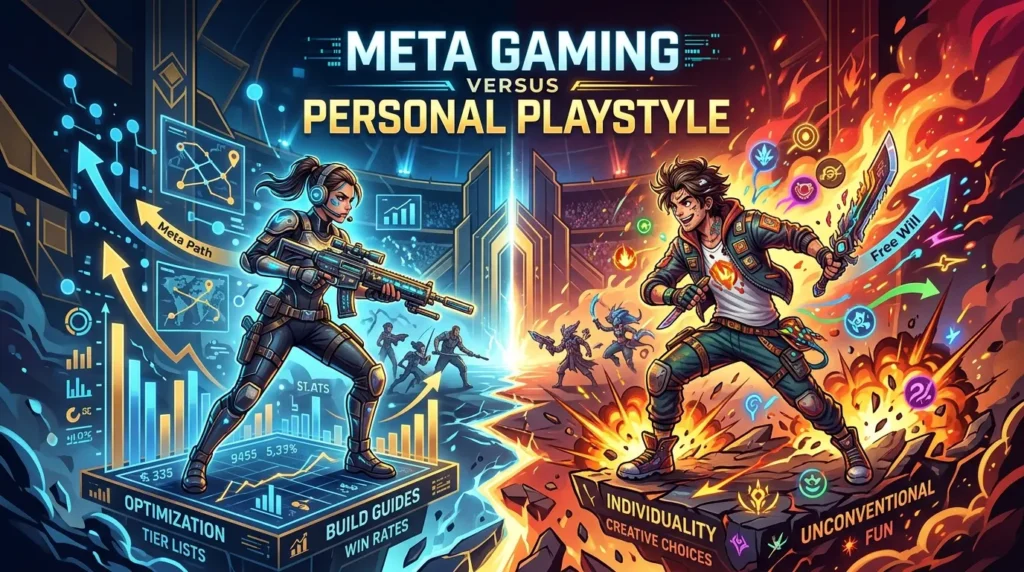
Following the meta can improve efficiency, but personal playstyle remains important. A strategy that works perfectly for one player may feel uncomfortable or ineffective for another.
For example, a player may prefer aggressive combat while the current meta favors a defensive strategy. Forcing that player into a defensive role may actually reduce their performance. Familiarity, confidence, reaction speed, and experience can matter more than a small statistical advantage.
Personal playstyle can sometimes become a competitive advantage. If everyone prepares for the most common strategy, an unusual but effective approach may catch opponents off guard.
This does not mean players should completely ignore the meta. Instead, they can use meta knowledge to understand the environment while adapting it to their strengths.
A good player might choose a popular weapon but use it differently from the standard approach. Another player might select a less popular character because they understand its mechanics exceptionally well.
The key is to distinguish between what is considered strong and what is strong for you.
Experimentation is especially valuable for beginners. Instead of immediately copying a professional build, players can test several options and identify which one feels natural.
Meta gaming becomes much more useful when it supports personal skill rather than replacing it. The goal should be informed decision-making, not blindly copying whatever is currently popular.
Advantages of Understanding Meta Gaming
Understanding meta gaming can provide several advantages. The first is better decision-making. Players who know which strategies are common can prepare for them before a match begins.
Meta knowledge can also shorten the learning process. Beginners often struggle because they do not know which options are effective. Studying established strategies gives them a useful starting point.
Another advantage is improved adaptation. When the game changes after an update, players who understand the principles behind the meta can adjust more quickly.
Meta awareness can also improve teamwork. In multiplayer games, players who understand common team compositions can communicate more effectively and coordinate roles.
Competitive players may gain an additional advantage by identifying trends before they become mainstream. Discovering a powerful strategy early can provide an opportunity to surprise opponents.
However, meta knowledge should always work alongside actual gameplay experience. Reading about a strategy does not automatically teach a player how to execute it under pressure.
The best results come from combining research with practice. Players can learn the theory, test it in real matches, study their mistakes, and make adjustments.
This creates a healthy improvement cycle. Learn the current meta, understand why it works, practice the fundamentals, and then adapt the strategy to personal strengths.
Disadvantages and Criticism of Meta Gaming
Meta gaming has critics because constantly following popular strategies can sometimes make games feel repetitive. If everyone uses the same character, weapon, deck, or build, matches may become predictable.
Another concern is that players can become overly focused on winning rather than enjoying the game. Some people begin treating every match like a competition, even when they originally wanted a relaxed experience.
Metas can also create pressure. Players may feel that they must use certain options to remain competitive. This can reduce experimentation and make less popular choices feel pointless.
In role-playing communities, metagaming can create a different problem. Using information that a character should not know may weaken immersion. A player might make decisions based on external knowledge rather than the character’s experiences.
There is also the risk of misinformation. Online communities sometimes declare something to be the best strategy without enough evidence. Players may copy advice that is outdated, exaggerated, or only effective in specific circumstances.
The solution is not to avoid meta gaming completely. Instead, players should approach it critically.
Ask why a strategy works, where it works, and whether it matches your goals. Check whether information is current and consider multiple viewpoints.
Games are ultimately designed to provide enjoyment. Meta knowledge can make competition more interesting, but players should still feel free to experiment, play casually, and choose options they genuinely enjoy.
How Meta Gaming Changes After Updates
Game updates can dramatically change the meta. Developers may introduce new characters, weapons, maps, abilities, items, or mechanics. Even a small adjustment can create unexpected strategic consequences.
When an update arrives, experienced players often begin testing immediately. They look for powerful combinations and determine which older strategies remain useful.
A new item may appear weak at first but become powerful after players discover a specific interaction. Likewise, a popular strategy may disappear after a seemingly minor nerf.
Major updates can create temporary uncertainty. During this period, players experiment with many possibilities before the community agrees on a new standard.
This period is sometimes called a developing or unstable meta. Guides created before the update may quickly become outdated, so players should pay attention to the date of their sources.
Learning to adapt is therefore more valuable than memorizing one specific build. Players who understand fundamental mechanics can respond to changes more effectively.
It is also important to read official patch information carefully. Developers may explain their reasoning behind balance adjustments, which can provide clues about intended gameplay.
After an update, players should avoid immediately assuming that the first popular strategy is the strongest. New metas require testing, and early community opinions can change quickly.
A flexible mindset helps players stay competitive without becoming frustrated whenever the game changes.
Meta Gaming in Different Game Genres
Meta gaming appears differently across various genres. In first-person shooters, the meta may involve weapons, character abilities, maps, movement techniques, and team strategies.
In MOBAs, players often discuss hero picks, item builds, lane strategies, jungle routes, team compositions, and objective control. The meta can shift significantly after balance patches.
Card games have particularly complex metas. Players build decks around cards that work together efficiently, while also considering which decks they expect opponents to use.
In strategy games, the meta can involve opening builds, resource management, unit compositions, technology choices, and timing attacks.
Role-playing games may have metas around character builds, equipment combinations, skill trees, and damage optimization.
Fighting games develop metas around character matchups, combos, neutral-game strategies, defensive options, and tournament trends.
Even cooperative games can have metas. Players may discover the most efficient character combinations, equipment choices, or mission strategies.
This variety shows that meta gaming is not limited to one type of player. Almost every game with meaningful choices can develop a meta.
Understanding the genre helps players interpret meta discussions correctly. The strongest strategy in a card game works differently from the strongest strategy in a shooter.
Regardless of genre, the basic principle remains similar: players discover effective approaches, share them, test counters, and continuously adapt.
How Beginners Can Learn Meta Gaming
Beginners do not need to understand everything about a game’s meta immediately. Starting with the fundamentals usually produces better results.
First, learn the basic rules and mechanics. A player who understands movement, combat, resources, objectives, and character abilities will have an easier time understanding advanced strategies.
Next, identify a few reliable options rather than trying to learn the entire meta. Choose one character, weapon, deck, or build and practice it consistently.
Watching experienced players can help. Focus on their decisions rather than simply copying their equipment. Ask why they move to a certain position, save an ability, or choose one target over another.
Patch notes are also useful because they explain how the game changes over time.
Beginners should also avoid worrying about tier lists too much. Tier lists can provide direction, but they do not replace practice. A player who understands a lower-ranked option may outperform someone who blindly selects a top-ranked choice.
Practice should remain the central part of learning. Use matches to test ideas and pay attention to mistakes.
Finally, remember that the meta is not a strict rulebook. It represents what the community currently believes is effective. You are allowed to experiment and develop your own approach.
The best beginner strategy is simple: learn the fundamentals, understand common strategies, practice consistently, and gradually develop your own game sense.
The Future of Meta Gaming
The future of meta gaming will likely become even more data-driven and dynamic. Modern games collect enormous amounts of gameplay information, allowing developers and communities to identify trends quickly.
Artificial intelligence and advanced analytics may also influence how players understand competitive strategies. Automated systems can analyze large numbers of matches and identify patterns that individual players might miss.
At the same time, developers are becoming more aware of how quickly communities discover optimal strategies. Live-service games can receive frequent balance updates designed to keep the environment fresh.
Content creators will continue to influence metas as well. A single popular video or livestream can introduce thousands of players to a new strategy.
Competitive gaming may also become more sophisticated. Professional teams already use analysts and detailed statistics, and future esports organizations may rely even more heavily on data.
However, human creativity will remain important. Games are not simply mathematical systems. Players can discover unexpected interactions, invent unconventional strategies, and challenge established assumptions.
The most interesting future metas may come from a combination of data and creativity. Statistics can reveal what works, while human experimentation can explain why it works and how it can be improved.
As gaming continues to evolve, meta gaming will remain an important part of competitive communities. Players who learn to adapt rather than simply copy trends will likely gain the greatest long-term advantage.
Conclusion
Meta gaming is an important part of modern gaming culture. It describes the strategies, trends, knowledge, and decision-making patterns that develop around a game’s rules and community. In competitive games, the meta can influence character choices, weapons, builds, team compositions, and tactics. In role-playing environments, metagaming can also describe the use of information that a character would not normally know.
Understanding the meta can help players improve, but it should never replace practice, creativity, or personal enjoyment. The strongest approach is to learn why popular strategies work, test them personally, and adapt them to changing circumstances. Because updates, discoveries, and player innovation constantly reshape games, no meta remains permanent. Staying curious, flexible, and willing to experiment is ultimately more valuable than blindly following a trend.
FAQs
What is meta gaming in simple terms?
Meta gaming means making gaming decisions based on knowledge about effective strategies, popular trends, statistics, or information outside the immediate gameplay situation. In competitive games, it often refers to the strongest strategies currently used by the community.
Why does the meta change in games?
The meta changes because developers release balance updates, players discover new strategies, new content appears, and competitive communities develop counters to existing tactics. A strategy that works today may become weaker after a future update.
Is meta gaming cheating?
Usually, meta gaming is not cheating. Using publicly available strategy information is generally a normal part of competitive gaming. However, using unauthorized information or exploits can violate a game’s rules.
Should beginners follow the meta?
Beginners can use the meta as a learning tool, but they should first understand the basic mechanics of the game. Copying a popular build without understanding how it works may not improve performance.
Can off-meta strategies be successful?
Yes. Off-meta strategies can work when they fit a player’s strengths or exploit weaknesses that opponents do not expect. The key is understanding why the strategy works and knowing when to use it.