A retro gaming handheld brings classic gaming into a compact device that you can carry almost anywhere. Instead of connecting an old console to a television, players can enjoy familiar games on a portable screen with built-in controls, rechargeable batteries, and modern convenience. Today’s handheld retro systems range from simple devices designed for older 8-bit and 16-bit games to more powerful models capable of running demanding classic titles and selected modern games.
They appeal to longtime gamers who want to revisit childhood favorites and new players who want to experience older gaming eras. Choosing the right device requires more than looking at appearance or price. Screen quality, controls, software support, battery life, performance, storage, build quality, and game compatibility all matter. This guide explains the most important things to know before choosing a retro handheld.
What Is a Retro Gaming Handheld?
A retro gaming handheld is a portable gaming device designed primarily to play older video games. These systems usually combine a built-in screen, directional controls, action buttons, speakers, battery, and processor inside a compact body.
Some handhelds are designed specifically for retro gaming, while others are general-purpose portable computers that can run emulators and gaming software. Their capabilities vary considerably.
Entry-level devices may focus on classic arcade titles and older console generations. More powerful handhelds can support additional systems, higher-resolution displays, wireless connectivity, and more demanding emulation.
The main attraction is convenience. Instead of maintaining several older consoles, controllers, cables, and cartridges, players can potentially carry many compatible games on one portable device.
However, a retro handheld does not automatically make every old game compatible. Performance depends on the hardware, operating system, emulator, and game system being emulated.
Software support is equally important. A device with excellent hardware can still provide a frustrating experience if its interface is confusing or its firmware receives little support.
Retro handhelds are popular because they combine nostalgia with modern portability. They let players revisit classic gaming experiences without necessarily rebuilding an entire vintage setup.
Why Are Retro Gaming Handhelds So Popular?
Retro handhelds have become popular because they combine nostalgia, portability, and convenience. Many players remember spending hours with classic consoles and arcade games, while younger gamers may want to explore older titles they missed.
Modern handheld hardware also makes portable retro gaming easier than it was in the past. Devices can include high-resolution screens, rechargeable batteries, compact controls, and modern storage options.
Another attraction is simplicity. A dedicated retro device can feel more focused than a smartphone because it includes physical gaming controls and a screen designed for play.
Retro gaming also offers a huge variety of genres. Players can revisit platformers, role-playing games, fighting games, racing titles, puzzle games, arcade classics, and strategy experiences.
The experience can feel different from modern gaming because older games often use straightforward mechanics. Players can quickly understand the basic objective and start playing.
Collectors also appreciate the design of retro-inspired handhelds. Manufacturers frequently create devices with shapes and button layouts inspired by different gaming eras.
Price can be another factor. Some entry-level handhelds cost less than modern gaming systems, although the quality and capabilities vary.
The growing interest in retro handhelds reflects a broader appreciation for gaming history. These devices make older styles of gaming accessible in a convenient modern format.
Best Features to Look for in a Retro Gaming Handheld
Choosing a retro handheld starts with understanding the features that actually affect the gaming experience. The display is one of the first things to consider. Resolution, brightness, viewing angles, color quality, and screen size can all influence comfort.
Controls are equally important. A responsive directional pad and comfortable buttons can make a major difference, especially in platformers and fighting games.
Performance should match the systems you want to play. A device designed for older 8-bit games does not necessarily need powerful hardware, while higher-level emulation requires more processing capability.
Battery life matters for portable gaming. A larger battery can provide longer sessions, but battery capacity should be considered alongside screen brightness and processor efficiency.
Storage is another consideration. Some handhelds include internal storage, while others support removable memory cards.
Build quality can affect long-term durability. A sturdy shell, reliable buttons, and good-quality controls can make a device more enjoyable over time.
Software is often overlooked. A clean interface, quick game launching, save-state support, customization options, and reliable firmware can improve everyday use.
Wireless features such as Wi-Fi and Bluetooth may also matter depending on the device.
The best feature set depends on your priorities. A simple handheld for classic games does not need every modern feature, while enthusiasts may want a more powerful and customizable system.
Retro Handheld Screen Quality
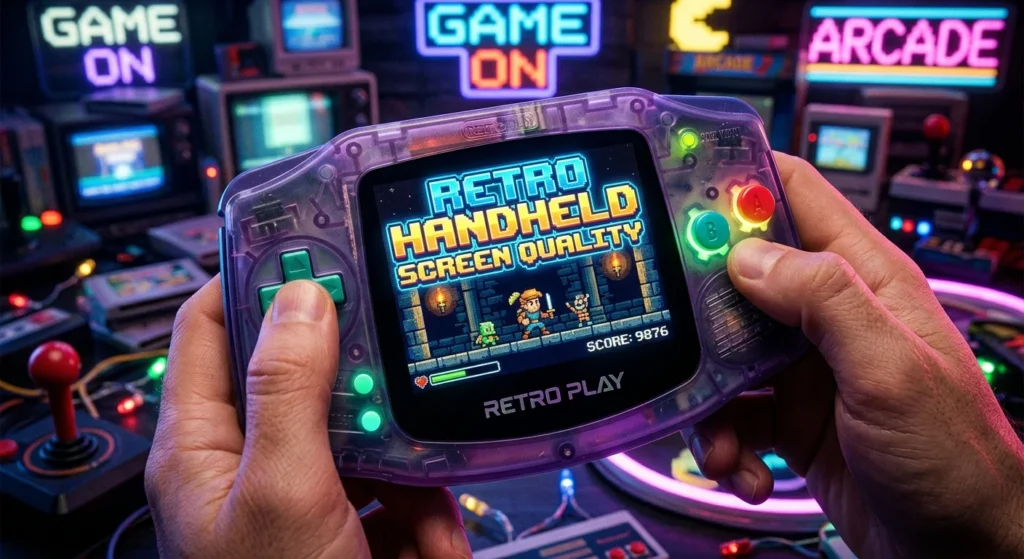
The screen is one of the most visible parts of a retro gaming handheld. A good display can make older pixel-based games look sharp and attractive.
Screen size should match the device’s intended portability. A larger screen may improve visibility, but it can also make the handheld less compact.
Resolution is another important factor. Some classic games were designed for low-resolution displays, so extremely high resolution does not always create a dramatically better experience. Good scaling and image processing can matter more.
Aspect ratio also deserves attention. Different gaming systems used different display proportions. A handheld that handles scaling well can preserve the original appearance of classic games.
Brightness and viewing angles affect outdoor and shared use. A screen that looks excellent indoors may be difficult to see under strong lighting.
Some devices use LCD panels with strong color reproduction, while others may offer premium display technology. The best choice depends on budget and preference.
Screen protection should also be considered for a portable device. A sturdy display and suitable protective case can reduce the risk of scratches or damage.
For retro gaming, image quality is about more than resolution. Accurate scaling, good colors, appropriate brightness, and low visual distortion all contribute to a satisfying experience.
A well-designed screen can make a relatively simple game library feel much more enjoyable.
Controls and Ergonomics
Controls can determine whether a retro handheld feels comfortable after a few minutes or several hours. The directional pad is particularly important because many classic games rely heavily on precise directional input.
Button placement should allow easy movement between controls. Buttons that feel too stiff, too soft, or poorly positioned can make certain genres frustrating.
Handheld size also affects comfort. Very small devices are convenient to carry but may feel cramped for users with larger hands.
Larger devices can provide better ergonomics but may sacrifice some portability.
Some modern retro handhelds include analog sticks, shoulder buttons, triggers, and additional controls. These features can expand the range of games a device can handle.
The quality of analog controls matters as well. Accurate movement is especially important for games that were not originally designed around a directional pad.
Grip design can reduce hand fatigue during longer sessions. Rounded edges and thoughtful button placement can make a major difference.
Before choosing a handheld, think about the games you actually plan to play. A simple directional pad may be ideal for classic platformers, while analog sticks become more useful for systems with 3D games.
Comfort is often more important than having the largest possible feature list. A device that feels good in your hands will usually receive more use over time.
Retro Gaming Handheld Performance
Performance determines which gaming systems a handheld can realistically emulate. Older systems generally require less processing power, while later generations can demand significantly more.
A device should not be judged solely by processor specifications. Emulator optimization, operating system efficiency, cooling, memory, and software configuration can also influence real-world results.
Entry-level handhelds may perform well with classic arcade games and older home consoles. Mid-range systems can expand compatibility to more demanding platforms.
More powerful handhelds can handle increasingly complex emulation, but higher performance often increases cost, power consumption, and heat.
Frame-rate stability matters because inconsistent performance can make games feel less responsive.
Input latency is another important consideration. Even a powerful device can feel unpleasant if controls respond slowly.
Storage speed can affect loading times, although it usually has less impact on gameplay than processor performance.
The best approach is to choose hardware based on the systems and games you want to play rather than buying the most powerful model available.
Performance claims should also be treated carefully. A device may technically launch a game but still provide an inconsistent experience.
Reliable reviews and real-world testing can help reveal how a handheld performs outside of marketing specifications.
Battery Life and Portable Gaming

Battery life is essential because portability is one of the main reasons people buy retro handhelds. A device that requires frequent charging may become inconvenient during travel.
Battery capacity is usually measured in milliamp-hours, but that number alone does not tell the entire story. Screen brightness, processor efficiency, wireless features, speaker volume, and software optimization can affect actual runtime.
Simple retro games may use less power than demanding emulation. A powerful handheld can therefore have different battery performance depending on what is being played.
Charging speed can also matter. USB-C charging is common on many modern handhelds and makes charging more convenient.
Players should consider how they plan to use the device. Short daily sessions require different battery capacity from long travel sessions.
Battery health matters over time as well. Rechargeable batteries naturally lose capacity after repeated use.
Portable gaming is most enjoyable when players can comfortably carry the device without constantly worrying about charging.
For frequent travelers, a protective case and suitable charging cable can be useful accessories.
Battery life should therefore be evaluated alongside performance, screen quality, and portability rather than treated as an isolated specification.
Retro Gaming Handheld Storage
Storage determines how much software and personal data a handheld can accommodate. Some devices use built-in storage, while others support removable memory cards.
The amount of storage needed depends on the type of games being used. Older games can occupy relatively little space, while larger files for later systems can require significantly more storage.
Removable storage provides flexibility. Users can potentially replace or upgrade a card without replacing the entire device.
However, storage quality matters. Poor-quality memory cards can cause reliability problems or corrupted data.
Users should also consider how the operating system organizes files. A simple interface makes it easier to find games and manage saved data.
Save states and configuration files require additional storage, although usually not as much as game files.
It is important to use games and software legally. Users should understand copyright rules and the licensing status of any game files they obtain.
A good storage setup should prioritize reliability rather than simply maximizing capacity.
For most players, the right amount of storage is enough to hold the games they genuinely want to play without creating unnecessary complexity.
Retro Handheld Operating Systems and Software
Software can make or break the retro handheld experience. A well-designed operating system should make it easy to browse games, change settings, save progress, and customize the device.
Some handhelds use simple proprietary interfaces, while others rely on Linux-based systems or other operating environments.
Open software can provide greater customization. Users may be able to install themes, adjust emulator settings, organize libraries, and modify system behavior.
However, customization can also increase complexity. Beginners may prefer a system that works well without requiring extensive configuration.
Firmware updates can fix bugs, improve compatibility, and add features. A manufacturer or community that actively maintains software can therefore add significant long-term value.
The user interface should respond quickly. Slow menus or complicated navigation can make a simple gaming session unnecessarily frustrating.
Save-state support is particularly useful for retro games. It allows players to pause progress at convenient points rather than relying only on the original game’s save system.
Software support should be considered before purchasing. Hardware specifications may look impressive, but the overall experience depends heavily on how well the operating system and emulation software work together.
Retro Gaming Handhelds and Emulation
Emulation allows modern hardware to reproduce the behavior of older gaming systems through software. Retro handhelds often rely on emulators to run compatible games.
The quality of emulation depends on several factors, including processor performance, emulator software, configuration, and the original system being reproduced.
Older systems are generally easier to emulate. More advanced systems may require stronger hardware and better optimization.
Some emulators provide features such as save states, graphical filters, controller remapping, fast-forward functions, and rewind options.
These features can make classic games more accessible while still preserving much of the original experience.
However, emulation does not automatically guarantee perfect accuracy. Some games may contain compatibility problems, visual glitches, audio issues, or performance inconsistencies.
Users should also understand the legal side of game software. Emulators are different from copyrighted game files, and laws regarding backups and game ownership vary by jurisdiction.
A responsible retro gaming setup should therefore consider both technical performance and legal access to games.
Emulation remains one of the key technologies behind modern retro handhelds because it allows compact hardware to support a wide range of classic gaming experiences.
Retro Gaming Handheld Portability
Portability is one of the biggest advantages of a retro handheld. A compact device can fit into a backpack, travel bag, or even a pocket depending on its design.
Small handhelds are excellent for short gaming sessions and travel. They can be used during breaks, waiting periods, or journeys where carrying a larger gaming system is inconvenient.
Larger handhelds may offer better screens and controls. They can be more comfortable for extended sessions but may take up more space.
Weight also matters. A heavy device can become tiring during long periods of handheld play.
Durability is another consideration for portable gaming. Devices carried frequently may encounter drops, scratches, dust, and other everyday risks.
A protective case can help preserve the screen and body. Screen protectors may provide another layer of protection.
Portability is ultimately about the balance between size, comfort, battery life, and performance.
The smallest device is not automatically the best portable gaming system. If its controls are uncomfortable or its screen is difficult to use, its compact design may not provide much practical value.
The ideal handheld is one that is easy to carry while still being comfortable enough to enjoy.
Retro Gaming Handheld Price and Value
Price ranges for retro handhelds vary widely. Affordable models may focus on basic systems, while premium devices can offer stronger processors, better displays, improved controls, and advanced software.
Value should be judged according to intended use. Buying an expensive handheld does not make sense if you only plan to play a small collection of simple classic games.
On the other hand, choosing a very inexpensive model may become frustrating if you want stronger emulation or better ergonomics.
Long-term value also depends on software support, build quality, battery reliability, and replacement options.
Accessories can increase the total cost. Cases, memory cards, chargers, screen protectors, and replacement controls may all affect the final budget.
Buyers should also consider whether they already own another device that provides similar functionality.
A good purchasing decision starts with a clear list of desired systems and features. From there, compare performance, controls, display quality, battery life, software, and price.
Avoid choosing a handheld solely because it has the largest number of supported systems. Compatibility claims can vary considerably in real-world use.
The best value comes from a device that provides the experience you actually want without paying for unnecessary features.
Retro Gaming Handheld for Beginners
Beginners should keep their first retro handheld simple. There is no need to start with the most powerful or complicated device.
The first step is deciding which games and gaming systems matter most. If the goal is to play classic 2D games, an affordable handheld may be enough.
Next, consider controls. A comfortable directional pad and responsive buttons can be more important than advanced specifications.
The interface should also be easy to understand. Beginners may prefer straightforward menus and minimal configuration.
Battery life and screen quality are useful everyday considerations. A handheld should be pleasant to pick up and play without requiring constant adjustments.
New users should also learn basic file and save management. Understanding where saved games and settings are stored can prevent unnecessary frustration.
Legal access to games should remain part of the setup. Users should understand the rules that apply to copyrighted game software in their region.
Beginners can gradually explore more advanced features after becoming comfortable with the device.
The goal is to enjoy retro games, not spend every gaming session troubleshooting technology.
A simple, reliable handheld that feels comfortable and works consistently can be a better beginner choice than a complicated device with features you may never use.
How to Choose the Right Retro Gaming Handheld
Choosing the right retro handheld becomes easier when you work backward from your gaming needs.
Start by identifying the systems and games you want to play. This immediately narrows the hardware requirements.
Then consider screen size and aspect ratio. Think about whether portability or visual comfort matters more.
Next, evaluate controls. If you enjoy fighting games, platformers, or action titles, directional-pad quality should receive serious attention.
Performance should match your target systems. Avoid paying for processing power you do not need, but do not choose hardware that cannot handle your preferred games.
Battery life should match your lifestyle. Travelers may want longer runtime, while home users may care less about maximum battery capacity.
Software support is equally important. Check whether the device receives updates and whether the interface is easy to use.
Build quality can influence long-term satisfaction. A handheld that feels solid and comfortable may provide more value over several years.
Finally, compare the total cost rather than the initial price. Include accessories and storage if needed.
The right retro handheld is not necessarily the most expensive, smallest, or most powerful model. It is the device that offers the best balance of compatibility, comfort, reliability, portability, and price for your specific needs.
Future of Retro Gaming Handhelds
The retro gaming handheld market continues to evolve as portable hardware becomes more capable and affordable. Better processors, improved screens, efficient batteries, and stronger software can expand what compact devices can accomplish.
Future handhelds may offer improved emulation, faster interfaces, better controls, and more sophisticated connectivity.
Display technology could also improve. Higher-quality panels can make classic pixel graphics look sharper while maintaining appropriate scaling.
Battery technology remains another important area. More efficient processors and improved batteries could increase gaming time without making devices significantly larger.
Software will likely remain just as important as hardware. Community-developed operating systems and frequent firmware updates can extend the usefulness of a handheld.
Design may also become more diverse. Some players prefer tiny pocket systems, while others want large screens and comfortable grips.
The growing interest in retro gaming suggests that older games will continue to have cultural value. Modern handhelds provide a convenient way to preserve access to gaming experiences from earlier generations.
However, future development should continue to respect game preservation, copyright, and legitimate access.
For players, the future looks promising. Retro handhelds can continue combining classic gaming experiences with the convenience of modern portable technology.
Conclusion
A retro gaming handheld offers an appealing combination of classic games and modern portability. The right device can make it easy to enjoy older gaming experiences with a dedicated screen, physical controls, rechargeable battery, and convenient software interface.
When choosing one, focus on the features that matter most to your actual gaming habits. Performance, screen quality, controls, battery life, storage, software support, portability, build quality, and price all deserve consideration. More expensive hardware is not automatically better if it does not match your needs.
Retro gaming is ultimately about enjoyment and preservation. Whether you want a compact device for short sessions or a powerful handheld for broader emulation, there is a wide range of options to consider. By understanding your preferred games and setting realistic expectations, you can choose a retro gaming handheld that delivers a comfortable and enjoyable experience for years to come.
FAQs
What is a retro gaming handheld?
A retro gaming handheld is a portable gaming device designed primarily to play older video games. It usually includes a built-in screen, physical controls, rechargeable battery, and software for running compatible games.
What should I look for in a retro gaming handheld?
Important features include display quality, comfortable controls, processing performance, battery life, storage, operating system, software support, build quality, and portability.
Are retro gaming handhelds legal?
The hardware and emulation software are separate from copyrighted game files. Laws concerning game backups, ROMs, and copyrighted software vary by location, so users should understand and follow the laws applicable to them.
Do all retro handhelds play every classic game?
No. Compatibility varies by hardware, emulator, software configuration, and the gaming system being emulated. A handheld may support some systems well while struggling with others.
Is a retro gaming handheld worth buying?
It can be worthwhile if you enjoy classic games and want a portable way to play them. The best choice depends on your preferred games, budget, desired performance, controls, and portability needs.