Reading and gaming may seem like two very different hobbies, but they can work surprisingly well together. Reading develops imagination, vocabulary, concentration, and knowledge, while gaming can build problem-solving skills, strategic thinking, coordination, and interactive creativity. For many people, combining books and video games creates a balanced form of entertainment that offers both quiet reflection and active participation.
The key is learning how to enjoy both activities without allowing one to completely replace the other. Whether you are a student, parent, gamer, book lover, or someone looking for healthier screen habits, understanding the relationship between reading and gaming can help you create a better routine. This guide explores the benefits, differences, similarities, time-management strategies, educational possibilities, and practical ways to enjoy reading and gaming together.
What Is Reading and Gaming?
Reading and gaming describes the combination of two popular leisure activities: consuming written content and interacting with digital games. Reading can include novels, nonfiction books, comics, magazines, educational materials, and digital articles. Gaming can involve PC games, console titles, mobile games, strategy games, role-playing games, and multiplayer experiences.
These activities use attention in different ways. Reading generally requires a person to process written language and create mental images. Gaming often combines visual information, sound, movement, decision-making, and immediate feedback.
The combination can create a varied entertainment routine. Someone might spend part of an evening reading a chapter of a novel and then play a strategy game for a short period. Another person might read gaming guides, fantasy novels, or stories inspired by games before playing.
Reading and gaming can also overlap. Many games contain detailed narratives, character development, fictional worlds, dialogue, and written lore. Players who enjoy story-driven games may naturally become interested in related books or other written material.
The important point is balance. Neither activity needs to eliminate the other. By managing time carefully, people can enjoy gaming while maintaining regular reading habits.
Benefits of Reading and Gaming Together
Reading and gaming can provide different forms of mental engagement. Reading encourages sustained attention and language processing, while many games require quick decisions and interaction with changing situations.
Reading regularly can expose people to new vocabulary, writing styles, ideas, cultures, and perspectives. Fiction can encourage imagination and help readers explore situations through the experiences of characters.
Gaming can provide opportunities to solve problems, recognize patterns, manage resources, make decisions, and respond to challenges. Strategy and puzzle games can be particularly focused on planning and logical thinking.
Combining the two activities can also reduce monotony. Spending every free hour on one form of entertainment may eventually feel repetitive. Switching between reading and gaming provides variety.
The activities can complement one another creatively. A person who reads fantasy novels may enjoy exploring fantasy game worlds. Someone interested in history may enjoy historical games and then read books about the periods represented in those games.
The benefits depend on the type of content and how a person uses it. Reading without understanding or gaming without healthy limits does not automatically produce positive results.
A balanced routine is therefore more useful than treating either hobby as universally better. Reading can provide quiet concentration, while gaming can offer interactive entertainment and challenge.
How Reading Improves Gaming Skills
Reading may support several skills that can be useful during gaming. Many games require players to understand instructions, character abilities, item descriptions, quests, maps, objectives, and dialogue.
Strong reading comprehension can make it easier to understand complex game mechanics. Players may quickly recognize what a mission requires or understand the effects of different equipment.
Reading can also improve vocabulary. Role-playing games and strategy titles sometimes use specialized terminology. Familiarity with language can help players understand objectives and communicate effectively with teammates.
Story-based games provide another connection. Players who enjoy reading may appreciate detailed narratives and take more interest in character development, world-building, and fictional histories.
Strategy games can also encourage players to research. A player might read a guide, compare different approaches, and then apply the information inside the game.
However, reading does not automatically make someone a better gamer. Gaming performance also depends on practice, reaction time, coordination, game knowledge, and individual experience.
The relationship is better understood as complementary. Reading can strengthen comprehension and information processing, while gaming gives players opportunities to apply information interactively.
This combination can be especially useful for players who enjoy complex games with large amounts of text or detailed systems.
How Gaming Can Encourage Reading
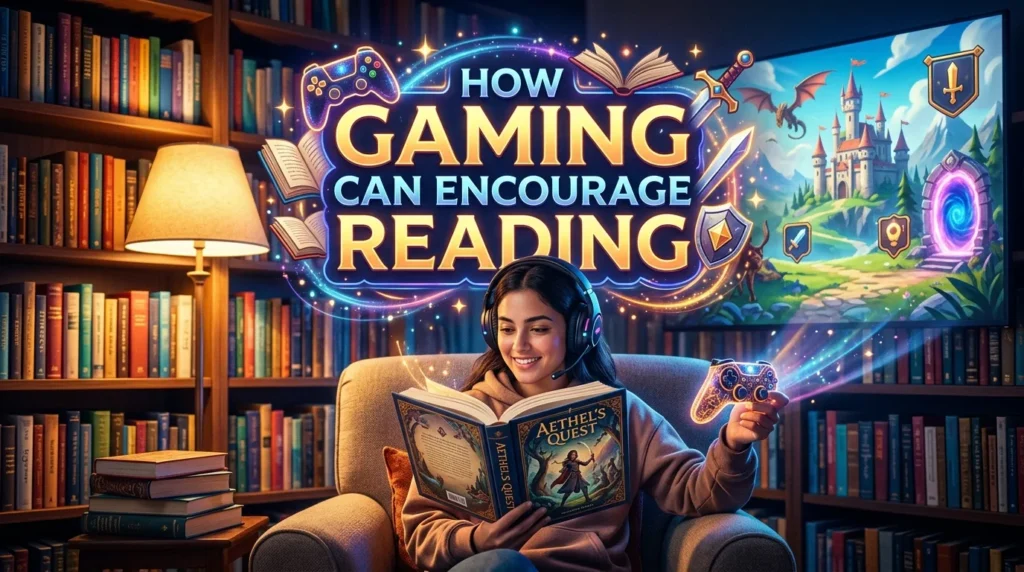
Games can sometimes introduce people to reading in an engaging way. Story-driven titles often contain dialogue, journals, character biographies, item descriptions, fictional documents, and extensive world-building.
A player who becomes interested in a game’s universe may want to learn more about its characters or setting. This can lead to novels, comics, lore books, fan-created stories, or historical resources.
Educational games can also use written information as part of gameplay. Players may need to read instructions, solve text-based puzzles, follow narratives, or understand informational content to progress.
Parents and educators can use this connection carefully. Instead of presenting gaming and reading as complete opposites, they can connect related interests.
For example, a child interested in a fantasy game might enjoy a suitable fantasy novel. Someone fascinated by a historical game might become interested in books about the historical period.
The transition should remain voluntary and age-appropriate. Forcing someone to read because they enjoy games may create negative feelings toward reading.
The strongest approach is to find genuine connections between the two interests.
Gaming does not replace traditional reading, but it can sometimes become a doorway to additional forms of storytelling and information.
Reading Versus Gaming: Understanding the Difference
Reading and gaming offer different experiences, so comparing them as if one must always be better is not particularly useful.
Reading is generally a more linear activity. The reader processes words, follows a structure, and creates mental images. The pace is often controlled by the reader.
Gaming is usually interactive. Players make choices, respond to events, solve problems, and receive immediate feedback. Some games provide highly structured experiences, while others offer large amounts of freedom.
Reading can encourage sustained concentration because the reader must follow text over an extended period. Gaming can demand divided attention because players may need to monitor multiple elements at once.
Neither experience is identical. The mental effort required depends heavily on the material. Reading a complex nonfiction book is different from reading a short article, just as solving a difficult strategy game is different from playing a simple casual game.
The best choice often depends on the goal. Someone seeking quiet reflection may prefer reading. Someone looking for interactive entertainment may choose gaming.
A healthy lifestyle can include both. The goal should not necessarily be to decide which activity wins but to understand how each fits into a person’s daily routine.
Reading and Gaming for Children
Children can benefit from both reading and age-appropriate gaming when adults provide reasonable guidance. Reading can support language development, imagination, comprehension, and general knowledge.
Gaming can provide interactive challenges and opportunities to practice problem-solving. Some games also encourage creativity, exploration, cooperation, and strategic thinking.
However, children need clear boundaries around both activities. Reading should not become a punishment, and gaming should not become an unlimited reward.
Parents can create predictable routines. For example, children might have dedicated periods for homework, reading, outdoor activity, gaming, family time, and sleep.
Game selection matters as well. Parents should consider age ratings, online interaction, in-game purchases, violence, chat features, and privacy settings.
Reading choices should also match a child’s age and interests. Allowing children to choose from suitable books can make reading feel more enjoyable.
The goal is not to remove gaming but to make room for different types of activity.
Parents can also participate. Reading together creates shared experiences, while cooperative games can provide opportunities for family interaction.
When children learn to manage different activities, they can develop healthier habits that continue into later life.
Reading and Gaming for Students
Students often struggle to balance entertainment with academic responsibilities. Reading and gaming can both fit into a student schedule if time is managed intentionally.
Academic reading should remain separate from entertainment reading when necessary. Textbooks and assignments require focused study, while novels and gaming-related materials can provide relaxation.
Gaming can become distracting when students use it as a way to avoid difficult tasks. Setting a specific gaming period after important responsibilities can help reduce this problem.
Reading can also be incorporated into study routines. Short reading sessions can provide a break from screens and support vocabulary development.
Students should pay attention to sleep as well. Late-night gaming or reading can reduce sleep time when activities continue beyond planned limits.
A practical routine might include completing schoolwork first, taking a short break, reading for a set period, and then enjoying gaming if enough time remains.
The exact schedule will differ between students.
The important principle is intentional use of time. Students do not necessarily need to give up gaming to succeed academically. They need to understand priorities and avoid letting entertainment consume the time required for essential responsibilities.
Reading and Gaming for Adults
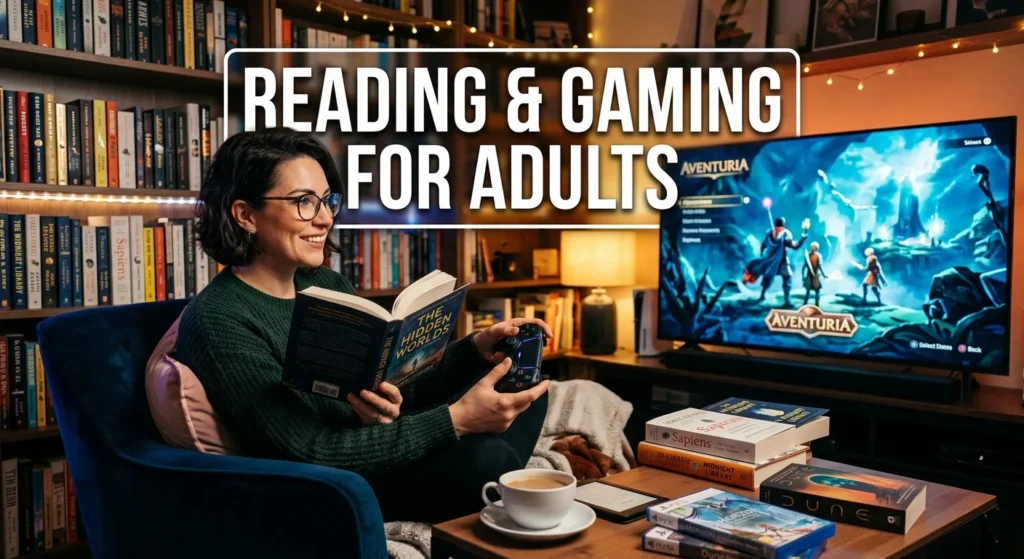
Adults often have busy schedules, making it difficult to maintain hobbies consistently. Combining reading and gaming can provide flexible entertainment options.
Reading can work well during quieter periods. A person might read before bed, during a commute, or during a peaceful weekend morning.
Gaming can provide a more interactive experience after work or during free time. Multiplayer games can also help adults maintain social connections with friends.
The challenge is avoiding excessive use. Work, family responsibilities, exercise, sleep, and personal commitments should remain priorities.
Adults can create realistic goals rather than demanding unrealistic amounts of reading. Even a few pages each day can maintain a reading habit.
Gaming sessions can also have clear stopping points. Finishing a match, completing a mission, or setting a timer can make it easier to stop.
Different days may require different routines. Someone might read more during the week and play longer gaming sessions on weekends.
The goal is sustainable enjoyment. Hobbies should provide relaxation and interest rather than becoming another source of pressure.
Storytelling in Reading and Gaming
Storytelling is one of the strongest connections between books and video games. Both can create characters, conflicts, settings, themes, and emotional experiences.
Books usually give the author direct control over the sequence of events. Games can allow players to influence parts of the experience.
Interactive storytelling can make players feel personally involved. Their choices may affect dialogue, missions, relationships, or endings.
Many modern games also use cinematic storytelling combined with exploration. Players may discover pieces of the story through conversations, environmental details, collectibles, and optional documents.
Reading offers a different form of immersion. Without graphics or interactive controls, readers build scenes through imagination.
Both formats can therefore create memorable fictional worlds.
People who enjoy one storytelling medium may naturally appreciate the other. A gamer who loves narrative games might enjoy novels with similar themes. A reader who enjoys fantasy literature might appreciate role-playing games with detailed fictional worlds.
The medium changes, but storytelling fundamentals remain recognizable.
Reading Gaming Guides and Walkthroughs
Reading is already part of many gaming experiences. Players frequently use guides, walkthroughs, strategy articles, forums, FAQs, and tutorials.
These resources can help players overcome difficult challenges or understand complex systems.
A good gaming guide should be clear and direct. It should identify the problem, explain the solution, and provide useful supporting information.
Players can also learn from guides by comparing strategies rather than blindly copying instructions. Understanding why a particular strategy works can improve independent problem-solving.
However, walkthroughs can sometimes reduce discovery. If a player reads every solution before attempting a challenge, some of the game’s mystery may disappear.
A balanced approach is to use guides only when needed.
Reading game lore can also deepen appreciation. Optional documents and character information may reveal details that are easy to miss during normal gameplay.
Gaming guides therefore demonstrate that reading and gaming are not separate worlds. Reading can become an active part of the gaming process itself.
Best Reading Genres for Gamers
Gamers have many reading options that connect naturally with their interests. Fantasy is a popular choice because many games use magical worlds, mythical creatures, and epic adventures.
Science fiction can appeal to players who enjoy futuristic settings, space exploration, technology, and artificial intelligence.
Mystery novels can attract players who enjoy investigation and puzzle-solving. Historical nonfiction can interest people who enjoy games based on real civilizations or historical events.
Graphic novels and comics provide another accessible option. Their visual storytelling can appeal to people who enjoy the combination of images and narrative.
Game-related books can also provide additional context. Some franchises have official novels, art books, lore collections, or behind-the-scenes publications.
The best genre is ultimately the one that holds the reader’s interest.
People should not feel that reading must always be educational to be valuable. Entertainment reading can provide relaxation and encourage a lasting reading habit.
Gamers who want to read more can begin with topics they already enjoy. Familiar interests often make it easier to build consistency.
Creating a Healthy Reading and Gaming Routine
A healthy routine begins with realistic expectations. Trying to spend several hours reading and several hours gaming every day may not fit a busy schedule.
Instead, people can create flexible blocks of time.
For example, a person might read for 20 to 30 minutes before gaming. Another option is reading during the morning and gaming later in the evening.
Using natural stopping points helps. A chapter can provide a reading endpoint, while a completed match or mission can provide a gaming endpoint.
Breaks are also important during long gaming sessions. Standing up, stretching, drinking water, and resting the eyes can make the experience more comfortable.
Sleep should remain a priority. Neither gaming nor reading should consistently push bedtime too late.
People should also include physical activity and social interaction in their routines.
A balanced day can contain work or study, movement, responsibilities, reading, gaming, and relaxation.
The ideal routine is personal. What works for one person may not work for another.
The main goal is intentional balance. Reading and gaming should fit into life rather than taking control of it.
Reading and Gaming for Better Focus
Both reading and gaming can involve concentration, but they train attention in different ways.
Reading generally requires sustained attention to words and ideas. The reader needs to remember previous information and connect it with new material.
Gaming often requires active attention to visual and auditory information. Players may monitor enemies, objectives, resources, maps, timers, and teammates.
Switching between these activities can provide different types of mental stimulation.
However, constant digital interruptions can make sustained reading more difficult. Notifications, social media, and multitasking may reduce concentration.
Creating a distraction-free reading environment can help. Turning off unnecessary notifications and choosing a comfortable place may make it easier to focus.
Gaming can also benefit from concentration. Players who remove distractions may perform better and enjoy the experience more fully.
Neither activity should be treated as a guaranteed concentration exercise. Results vary according to the individual and the type of content.
The useful lesson is that focused engagement matters. Whether someone is reading a novel or playing a strategy game, giving full attention to the activity can create a richer experience.
The Future of Reading and Gaming
Technology continues to bring reading and gaming closer together. Interactive stories, narrative games, digital books, virtual environments, and educational platforms already combine elements from both worlds.
Games can deliver sophisticated stories that rival other entertainment formats. At the same time, digital reading platforms make books available across phones, tablets, computers, and dedicated reading devices.
Educational technology may create even more connections. Interactive learning experiences can combine text, visuals, challenges, and feedback.
Artificial intelligence may also influence how people discover stories and games. Personalized recommendations could help users find books and games that match their interests.
Despite these changes, traditional reading and conventional gaming are unlikely to disappear simply because new formats emerge. People enjoy different forms of entertainment for different reasons.
The future may therefore involve more choice rather than one dominant format.
Reading and gaming can continue to coexist as complementary hobbies. One can provide quiet imagination and reflection, while the other offers interaction, challenge, and exploration.
The most important factor will remain how people use technology. Balanced habits and thoughtful choices can help ensure that entertainment remains enjoyable and useful.
Conclusion
Reading and gaming do not need to compete for attention. They can complement each other by offering different types of entertainment, learning, imagination, and engagement. Reading can strengthen language skills, introduce new ideas, and encourage deep storytelling, while gaming can provide interactive challenges, strategic thinking, creativity, and social experiences.
The best approach is balance. Choose suitable games, explore books that match your interests, create realistic schedules, protect sleep, and make time for responsibilities and physical activity. Whether you are a student, adult, parent, gamer, or book lover, combining these hobbies thoughtfully can create a richer daily routine.
Ultimately, reading and gaming are both ways to explore worlds, solve problems, discover stories, and enjoy your free time. The right balance allows you to experience the strengths of both without letting either activity take over your life.
FAQs
Is reading better than gaming?
Neither activity is automatically better. Reading and gaming provide different experiences and can offer different benefits. A balanced routine can include both.
Can gaming encourage children to read?
Yes. Story-driven games and game-related interests can sometimes encourage children to explore novels, comics, lore, and other reading materials that match their interests.
How can I balance reading and gaming?
Create specific periods for each activity and prioritize school, work, sleep, exercise, and responsibilities. Short, consistent reading sessions can work well alongside planned gaming time.
Does reading help with gaming?
Reading can support comprehension, vocabulary, and understanding of instructions and narratives. However, gaming performance also depends on practice, coordination, reaction time, and game-specific knowledge.
What should I read if I enjoy gaming?
Fantasy, science fiction, mystery, graphic novels, historical nonfiction, and books connected to your favorite game genres can be good starting points. Choose subjects that genuinely interest you to make reading easier to maintain.